
From animal connective tissue, by taking it apart. Collagen powder begins as hide, bone, skin or scales — usually cattle, pigs or fish — which are cleaned, pre-treated with acid or alkali, then simmered in hot water so the collagen unwinds and dissolves out as gelatine. That gelatine is cut down further with enzymes, a step called hydrolysis, into the short fragments sold as collagen peptides, which are filtered, dried and milled into powder. Hydrolysis is the step that matters to you: it is why the finished powder dissolves in cold water, sets no jelly and tastes of almost nothing. Everything else on the ingredients list is there for flavour, flow or shelf life.
It starts as connective tissue
Collagen is the main structural protein in skin, tendon, ligament, bone and cartilage — the material that holds an animal together and gives tissue its tensile strength. It is not a vitamin or an extract. It is a building material, and the only place to get it is an animal, which is why a truly vegetarian collagen does not exist.
So the raw material is whichever part of a carcass is richest in it and would otherwise be waste. Bovine collagen comes from cattle hide and bone, porcine from pig skin, and marine collagen from fish skin and scales left over from filleting. Chicken sources are usually cartilage rather than skin. None of that is a secret or a scandal; it is the ordinary economics of using the whole animal, and it is the reason a collagen tub is one of the few supplements whose source species appears on the front of the pack.
Cleaning, then extraction
Raw hides and skins arrive with hair, fat and minerals attached, so the first stage is mechanical and chemical cleaning: trimming, washing, degreasing. Bone goes through a demineralising acid soak to strip out the calcium phosphate that makes it rigid, leaving the protein scaffold behind.
Then comes a pre-treatment, and this is where the two classic routes split. An alkaline soak in lime is the traditional approach for thick bovine hide; an acid soak suits thinner material such as pig skin and fish skin. Either way the point is the same — to loosen the chemical cross-links holding collagen’s triple-helix fibres into a tough, insoluble bundle. Without that step the hot water stage would barely touch it.
Extraction itself is closer to making stock than to anything industrial-sounding. The pre-treated material is held in hot water, the loosened helices come apart, and the protein goes into solution. The liquid is filtered, concentrated by evaporation and dried, and what you have at that point is gelatine — the same substance that sets a trifle. Gelatine is the halfway house: it dissolves in hot water, gels as it cools, and is useless in a cold drink.
Hydrolysis, and what “peptides” means on a tub
To turn gelatine into a powder you can stir into cold coffee, the long protein chains have to be chopped shorter. That is done with protease enzymes, which cut the chains at specific points under controlled temperature and acidity until the average fragment is a fraction of its original length. The reaction is then stopped by heating, and the enzymes are inactivated and left behind.
“Hydrolysed collagen”, “collagen hydrolysate” and “collagen peptides” all describe that same material. Some brands print an average molecular weight in daltons, which is simply a measure of fragment size — a few thousand daltons rather than the hundreds of thousands of an intact fibre. It is a manufacturing specification, not a promise, and a smaller number on a tub is not a claim about you.
The liquid hydrolysate is filtered again, sometimes passed through carbon or ion exchange to strip colour and odour, and then spray dried: atomised into a tower of hot air so each droplet dries in seconds into a hollow particle. That is what makes the powder wet and dissolve so readily. Finally it is sieved and milled to an even grain. Collagen peptides: what they are and how to use them covers the practical end of that, and what actually happens to collagen when you swallow it picks the story up after the tub.
Why it tastes of almost nothing
An unflavoured bovine hydrolysate has a faint savoury note, a little like a weak stock, and most people lose it entirely in coffee or a smoothie. Marine collagen is the awkward one: fish skin carries a smell that survives processing, so marine powders are usually filtered and deodorised harder, and some are lightly flavoured to cover what is left.
Where a collagen powder is flavoured, it carries the same short list of helpers as any other flavoured powder — a flavouring, a high-intensity sweetener, sometimes an acid or an anti-caking agent. What else is in a protein powder besides the protein walks through that group in detail, and the logic is identical here. Some tubs also list separate added ingredients such as vitamin C or hyaluronic acid, which are ingredients in their own right rather than part of the collagen.
What a multi-collagen blend is
Different raw materials are rich in different collagen types. Hide and skin are dominated by type I with some type III alongside it; cartilage is mostly type II. A multi-collagen powder simply means more than one of those raw materials went into the same tub, so the finished blend contains a wider spread of types than a single-source one.
That is a statement about composition and nothing more. A blend is not permitted to claim an advantage over a single source, and we are not going to imply one. Whether a collagen powder counts as a protein supplement at all is a separate question, and how it compares with whey deals with it honestly.
What a collagen product is allowed to say
Here is the part most collagen marketing skips. On the Great Britain nutrition and health claims register there is no authorised health claim for collagen at all — not one. Four proposed collagen claims were assessed and refused, including claims about joint function and about skin firmness and elasticity. A refused claim cannot be used in any form, reworded or hinted at, which is why nothing on this page tells you what collagen will do for you.
The only authorised wording that even mentions the word collagen belongs to vitamin C, as a claim for that vitamin, conditional on the food qualifying as a source of it. It is a vitamin C claim and not a collagen one, and treating it as a back door into collagen marketing is exactly the move the register exists to prevent. Do you need vitamin C with collagen? sets out why. We quote no claim for hyaluronic acid, for any excipient, or for a peptide size, because we only quote claim wording we have checked against the Great Britain register ourselves.
Reading a collagen tub
Knowing how the powder is made makes a label much quicker to read:
- Check the source species. Bovine, porcine, marine or a blend. It matters for a fish allergy, and for anyone avoiding pork or beef for religious or personal reasons.
- Look for the hydrolysed wording. Hydrolysed collagen or collagen peptides will dissolve cold; plain gelatine will not.
- Count the extras. An unflavoured powder may have a single ingredient. A long list usually means a flavour system, not more collagen.
- Read the serving, not the per-100g column. A scoop is rarely 100g, so the two are not interchangeable. Why supplement doses vary so much between brands covers that trap.
- Treat dalton figures as spec, not benefit. Useful for comparing two powders, meaningless as a promise.
The rest of our plain-English explainers sit on the collagen topic page.
Where the Multi Collagen Peptides sit
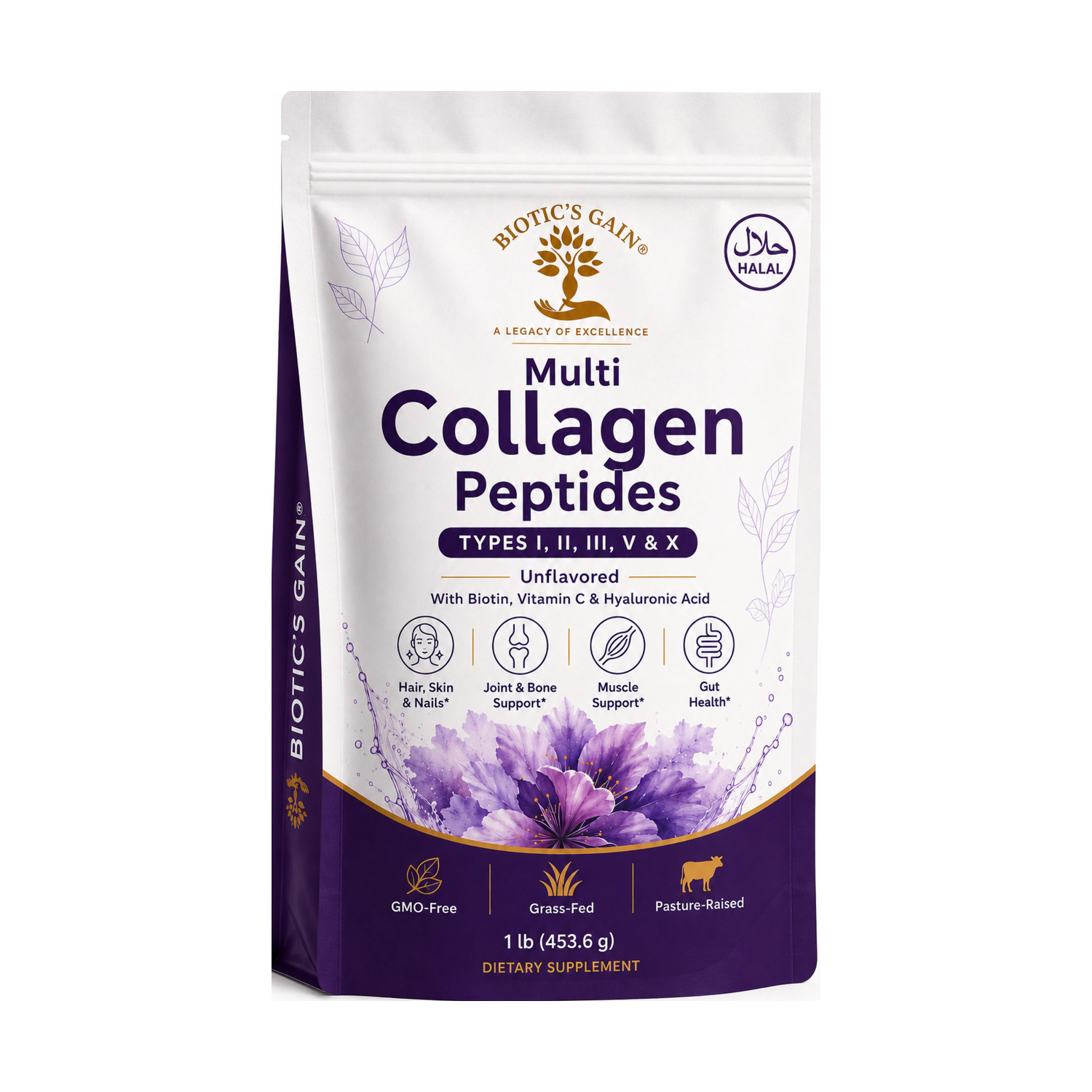
Biotic’s Gain Multi Collagen Peptides is a hydrolysed collagen peptide powder, multi-collagen meaning more than one source material in the tub. That is a description of what is in it, in the same way a weight or a scoop size is — not a promise about what it will do, because as above, no such promise is permitted for collagen in Great Britain.
For the source species, the types it contains and whether anything else has been added, including vitamin C, the ingredients list on your own tub is the authority rather than anything written about the product elsewhere — ours included. That holds for every brand on the shelf. If you take prescription medicines, or you are pregnant or breastfeeding, a pharmacist is the easiest person to ask before adding anything new.
Related reading
Biotic’s Gain supplements are food supplements. They are not a substitute for a varied and balanced diet or a healthy lifestyle, and no food supplement can treat, prevent or cure any condition. Do not exceed the recommended daily portion. If you are pregnant, breastfeeding, taking medication or under medical care, speak to a pharmacist or GP first.


Leave a Reply