
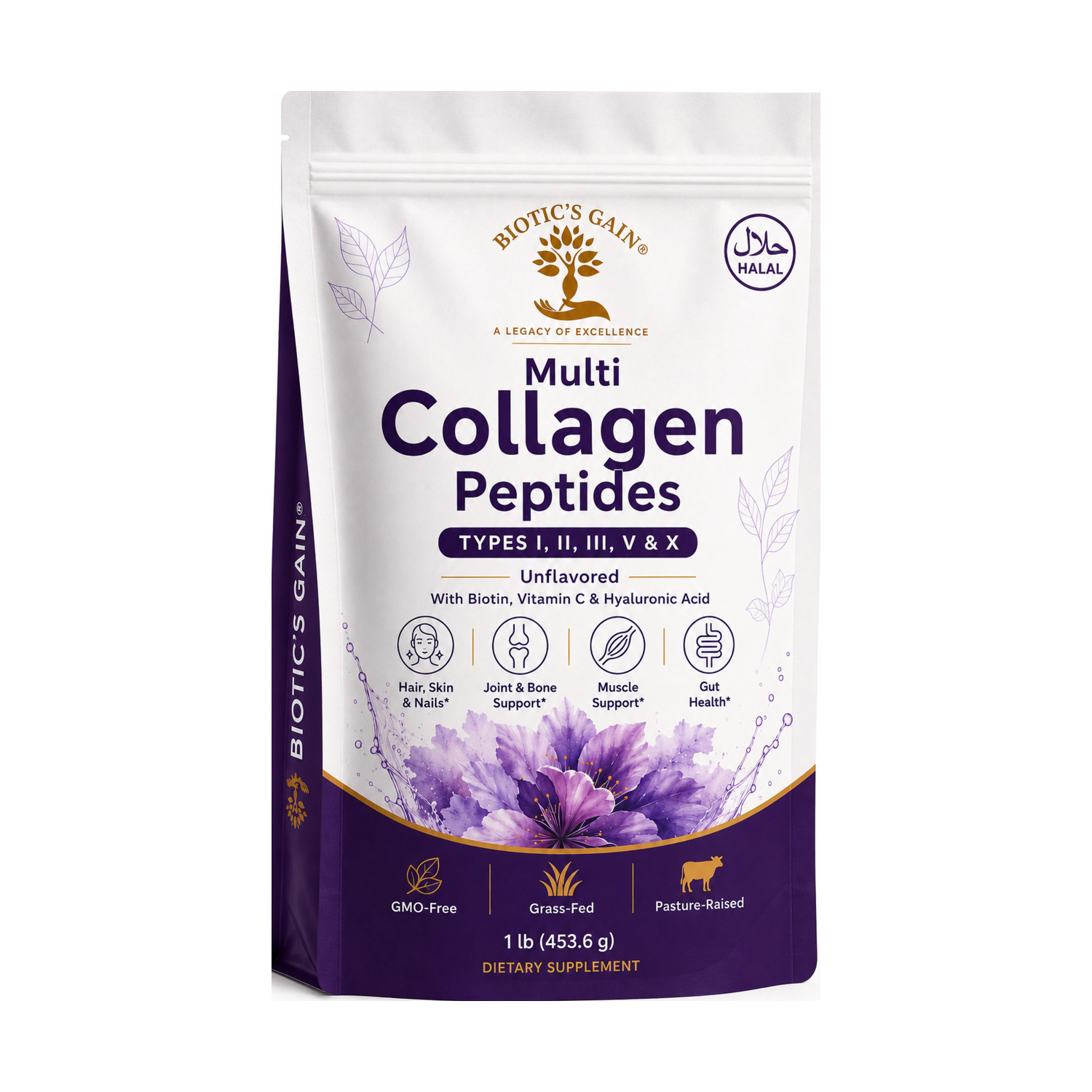
Vitamin C and collagen are linked, but not in the way most supplement packaging implies. Your body builds its own collagen continuously, and vitamin C is one of the nutrients that process depends on — which is why Great Britain authorises the claim that vitamin C contributes to normal collagen formation for the normal function of blood vessels, bones, cartilage, gums, skin and teeth. That claim belongs to vitamin C as a nutrient, and it may only be used on a food that genuinely supplies vitamin C. It is not a claim for collagen powder. So you do not need to time vitamin C alongside a collagen supplement; you need adequate vitamin C for ordinary dietary reasons, which most British diets supply.
Where the link between vitamin C and collagen comes from
Collagen is the most abundant protein in the human body. It is the structural material in skin, tendons, ligaments, the organic part of bone and the walls of blood vessels, and the body is constantly making more of it and breaking old material down. That manufacturing runs on amino acids — glycine, proline and hydroxyproline in particular — and on a handful of cofactors that the enzymes involved cannot work without.
Vitamin C is one of those cofactors. The enzymes that modify proline and lysine residues, a step that lets the finished collagen molecule hold its shape, require vitamin C to do their job. This is settled, uncontroversial nutritional biochemistry, and it is the reason vitamin C ended up with a collagen-related claim on the register while collagen itself did not.
Notice what that describes. It is the collagen your own body assembles from raw materials, not collagen you swallow — a different question, covered in what actually happens to collagen when you swallow it.
The authorised wording, word for word
Only claims that appear on the Great Britain nutrition and health claims register may be used on food and food supplements sold in Great Britain. The vitamin C entry relevant here reads:
Vitamin C contributes to normal collagen formation for the normal function of blood vessels, bones, cartilage, gums, skin and teeth.
Three things about that sentence are worth sitting with. The first is the word “normal”, which appears three times and cannot be removed. A brand is not permitted to swap it for “improved”, “stronger”, “better” or “boosted” — the claim describes a nutrient’s part in a body working as it ordinarily does, not an upgrade to it.
The second is “contributes to”. Light rewording is allowed where the meaning is genuinely preserved, so “helps” or “supports” can stand in, but the claim cannot be inflated into cause and effect the register never granted.
The third is the condition attached to it. A claim like this can only be used on a product that qualifies as a source of the nutrient under the labelling rules. A trace of vitamin C, added for the sake of a line on the front of the tub, does not unlock it.
Why the claim does not transfer to a collagen powder
Health claims attach to nutrients, not to whichever ingredient a brand has put in the product name. That distinction is easy to miss on a shelf, and it is the whole reason this article exists.
Collagen has no authorised claim of its own in Great Britain. Four collagen claims were assessed and ended up on the rejected list, including wording about joint function and about skin firmness and elasticity. Rejected is a stronger status than simply unproven: those specific claims were considered and turned down, so they must not appear in British copy at all.
The vitamin C claim is therefore the only route by which the word “collagen” can legally appear in a health claim on a British label — and it is still a vitamin C claim. If a collagen powder contains enough vitamin C to qualify, the wording may be used, and the honest reading of it on that tub is “the vitamin C in here plays a part in the collagen your body makes.” It is not a statement that the collagen peptides in the scoop do anything.
This is worth knowing because the packaging convention across the category is to add a modest amount of vitamin C, print the authorised sentence, and let the shopper join the two halves together themselves. Nothing illegal has happened. The implication is just doing work the claim itself never did.
So do you need to take them together?
Not in the sense of timing. Collagen peptides are digested as protein, broken into amino acids and short peptides, absorbed and drawn on by the body as it sees fit. That happens whether or not a vitamin C tablet went down with them.
What actually matters is that your overall vitamin C intake is adequate on an ordinary day-to-day basis, for all the reasons vitamin C matters generally. Vitamin C is water-soluble and the body holds no large reserve of it, so regular modest intake does more than an occasional large dose. Whether that intake arrives ten minutes either side of a scoop of collagen is not a meaningful variable.
Where vitamin C comes from in an ordinary British diet
Most people reaching for a collagen powder are not short of vitamin C. It is one of the easier nutrients to come by:
- Peppers, particularly red and yellow ones, which are unusually rich in it
- Blackcurrants, strawberries, kiwi fruit and citrus
- Broccoli, Brussels sprouts, cabbage and kale
- Potatoes, which are not concentrated in vitamin C but are eaten in enough quantity in Britain to contribute a real share
Vitamin C is sensitive to heat and leaches into cooking water, so raw, steamed or briefly cooked vegetables retain more than ones boiled hard and drained. That is a reason to steam the broccoli rather than a reason to buy a supplement.
If you are already taking a collagen powder
Turn the tub round and read the ingredients and the nutrition panel. If vitamin C is in there, you will likely also see the authorised sentence somewhere on the pack — now you know which nutrient it belongs to. If vitamin C is not in there, nothing is missing and nothing needs fixing; you are getting it from food, as most people do.
What is worth avoiding is stacking. If a collagen powder, a multivitamin and a separate vitamin C tablet are all in the cupboard, it is easy to end up taking several times what you intended without ever deciding to. More is not automatically better with a water-soluble vitamin; the surplus is largely excreted, and very high intakes can be uncomfortable digestively.
What Biotic’s Gain says about Multi Collagen Peptides
We describe Multi Collagen Peptides factually: what it is, which collagen types it draws on, that the peptides are hydrolysed, and how people tend to use the powder. We do not attach a health claim to it, because Great Britain does not authorise one for collagen and we are not going to borrow vitamin C’s claim to imply something about a different ingredient.
More on the wider picture on our collagen tips and guides page.
Related reading
Biotic’s Gain supplements are food supplements and are not medicines. They are not intended to diagnose, treat, cure or prevent any disease, and they are not a substitute for a varied, balanced diet and a healthy lifestyle. Do not exceed the stated daily intake. If you are pregnant, breastfeeding, taking medication or under medical supervision, speak to your GP or pharmacist before starting a new supplement.


Leave a Reply