
No. Collagen is a structural protein found only in animals, so there is no plant that produces it and no such thing as plant collagen in the ordinary sense. Supplements sold as vegan or vegetarian collagen are one of two quite different things: a blend of amino acids, vitamin C and minerals sold as support for the collagen your own body makes, or genuine collagen protein grown by fermentation using engineered yeast or bacteria, which is still scarce and expensive. Marine collagen is fish, so it is not vegetarian either. In Great Britain collagen itself carries no authorised health claim, which matters a great deal for how any of these products may be described.
Why no plant makes collagen
Collagen is the main structural protein in animal connective tissue. It is what gives skin its pliability, tendons and ligaments their tensile strength, cartilage its cushioning and bone its organic framework, and it lines the walls of blood vessels. Plants build their structure out of entirely different materials — cellulose, hemicellulose, pectin and lignin — and nothing in a plant cell does the job collagen does. No plant carries the genetic instructions to make it.
So plant collagen is not a gap in the market waiting to be filled. It is a contradiction in terms, in the same way that plant lactose would be.
It is worth separating two ideas that packaging tends to run together. Your own body makes collagen continuously, from amino acids and a small number of cofactors, and it does that whether or not you eat animal products. Vegans assemble collagen exactly as everybody else does. What does not exist is a plant you can harvest ready-made collagen from.
Where the collagen in supplements comes from
Almost every collagen supplement on a British shelf draws on one or more of a short list of animal sources: bovine hide and bone, porcine skin, fish skin and scales, chicken cartilage, and eggshell membrane. The raw material is cooked to produce gelatine, which is collagen partly broken apart, and then hydrolysed further into short peptides so that the powder dissolves in a cold drink instead of setting into a jelly. Collagen peptides: what they are and how to use them goes through that processing in more detail, and what actually happens to collagen when you swallow it covers what the body does with the result.
Marine collagen causes the most confusion. It sits on the shelf next to the algae and greens powders, the word sounds botanical, and plenty of shoppers assume it is the plant-friendly option. It is fish. Pescatarians may be happy with it; vegetarians and vegans are not buying what they think they are buying.
Eggshell membrane is the one genuine grey area. It is a by-product of egg production rather than of slaughter, which some vegetarians are comfortable with and others are not. It is still animal-derived, and a product containing it cannot honestly be called vegan.
What is actually in a tub labelled vegan collagen
Two completely different kinds of product share that label, and the price usually tells you which one you are holding.
The common one is a collagen builder, and the important thing about it is that it contains no collagen at all. A typical formula is vitamin C, the amino acids glycine, proline and lysine, sometimes zinc or copper, silica from bamboo extract, and a few botanical extracts. The reasoning printed on the pack is that these are the raw materials and cofactors your body draws on when it builds its own collagen, so supplying them is the plant-based route to the same end. That reasoning is not absurd, but it is doing a lot of implying. These are nutrients and amino acids, and whether topping them up beyond an already adequate diet changes anything visible is a separate question that the label is not permitted to answer.
The rare one is fermented collagen, sometimes sold as biodesigned or precision-fermented. Here the collagen sequence is introduced into yeast or bacteria, which then produce real collagen protein in a tank, and it is harvested and purified without an animal anywhere in the process. This is genuine collagen and genuinely vegan. It is also expensive, used mostly in cosmetics and in laboratory and medical materials, and in Great Britain an ingredient of that sort needs clearing as a novel food before it can be sold in a supplement. If a tub is cheap and says vegan collagen, it is a builder blend.
The practical advice is the same either way: turn the tub round and read the ingredients list rather than the front of the pack.
What Great Britain allows anyone to claim
Only claims on the Great Britain nutrition and health claims register may be used on a food or food supplement sold here, and collagen has no authorised claim of its own. Four collagen claims were assessed and ended up on the rejected list, including wording about joint function and about skin firmness and elasticity. Rejected is a stronger status than unproven: those claims were considered and turned down, so they must not appear in British copy at all. That applies to a vegan builder blend exactly as it applies to a bovine powder.
The only authorised wording that mentions collagen at all belongs to vitamin C:
Vitamin C contributes to normal collagen formation for the normal function of blood vessels, bones, cartilage, gums, skin and teeth.
That sentence belongs to the nutrient, not to the product name, and it may only be used where the food genuinely qualifies as a source of vitamin C. The word normal appears three times and cannot be removed, and it cannot be traded up for improved, stronger or boosted. So a plant-based builder blend with enough vitamin C in it may carry that line legitimately — and it is still a vitamin C claim, not evidence for anything else in the tub. Do you need vitamin C with collagen? works through that wording in full.
We only quote claim wording we have checked against the Great Britain register ourselves, which is why you will not find us attaching claims to glycine, proline, silica or botanical extracts anywhere on this site.
If you are vegetarian or vegan, what is worth doing instead
The honest answer is unglamorous. Collagen is built from amino acids, so the dietary question that actually matters is whether you are eating enough protein across the day and getting a reasonable spread of amino acids from it. That is ordinary dietary practice rather than a claim, and can you get enough protein on a vegetarian diet? sets out the per-portion figures for yoghurt, eggs, pulses, tofu, grains and the rest.
Vitamin C is easy to come by in a British diet — peppers, blackcurrants, kiwi, citrus, broccoli and brassicas, and potatoes in the quantities people eat them. Most people reaching for a collagen product are not short of it.
And if your interest in collagen was really about protein rather than about skin, note that whey is dairy. A whey isolate is suitable for vegetarians, though not for vegans, and is collagen a protein supplement? explains why collagen is a poor substitute for one in any case.
Reading a label when you are avoiding animal products
- A named source — bovine, porcine, marine, fish, chicken or eggshell membrane — means animal-derived, with no exceptions
- Hydrolysed collagen or collagen peptides with no source stated is still animal-derived unless the pack specifically says fermented
- Gelatine is cooked collagen, and that includes the capsule shell as well as the contents
- Collagen builder, collagen complex or collagen support usually means there is no collagen in the tub at all
- A registered vegetarian or vegan trademark on the pack is the quickest answer there is
Where Multi Collagen Peptides sit
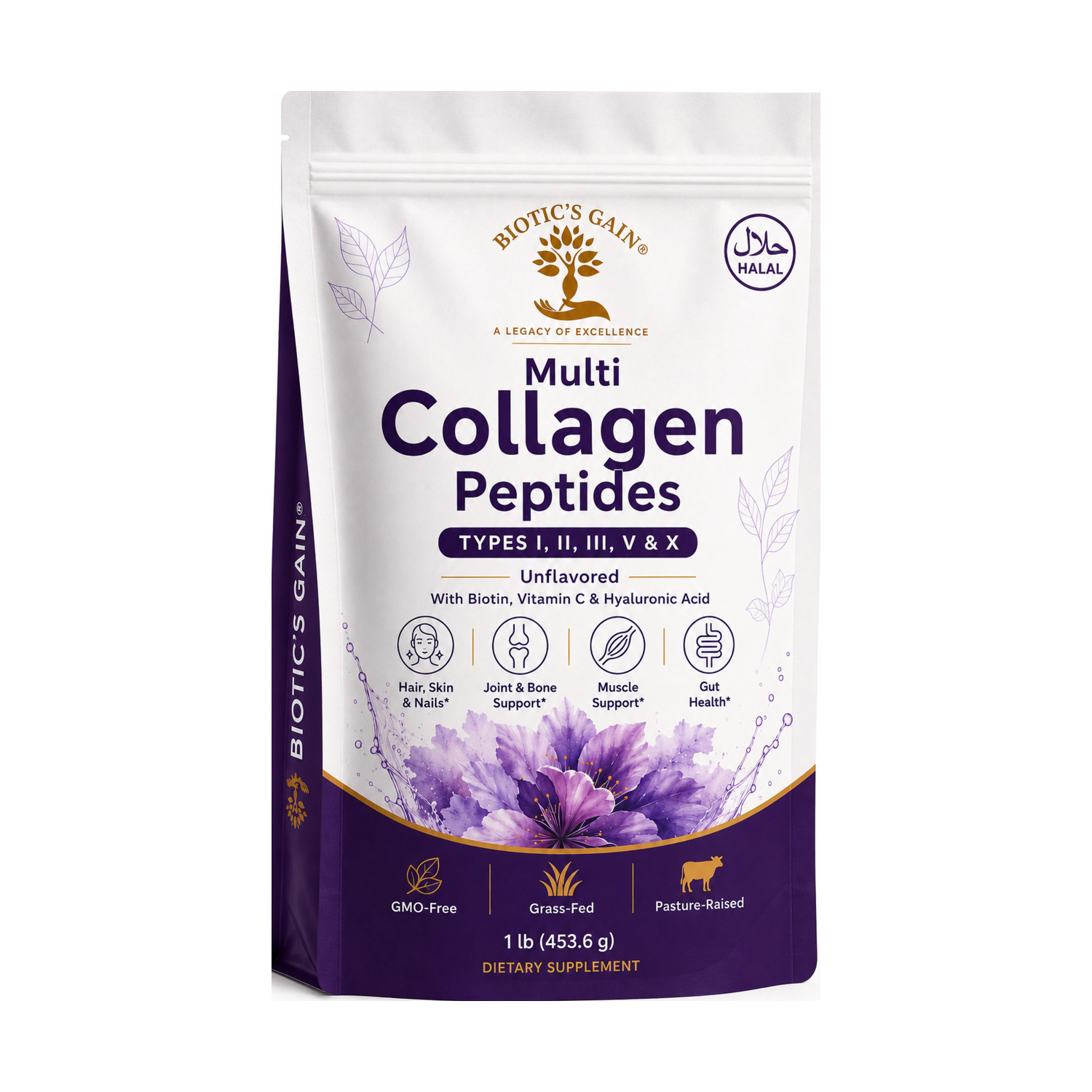
Biotic’s Gain Multi Collagen Peptides is an animal-derived product, so it is not suitable for vegetarians or vegans. We would rather say that in a sentence than leave somebody to work it out from the ingredients panel in a shop.
We describe the powder factually — which collagen types it draws on, that the peptides are hydrolysed, and how people tend to use it — and we attach no health claim to it, because Great Britain authorises none for collagen and we are not going to borrow vitamin C’s claim to imply something about a different ingredient. There is more on the wider picture on our collagen tips and guides page.
Related reading
Biotic’s Gain supplements are food supplements and are not medicines. They are not intended to diagnose, treat, cure or prevent any disease, and they are not a substitute for a varied, balanced diet and a healthy lifestyle. Do not exceed the stated daily intake. If you are pregnant, breastfeeding, taking medication or under medical supervision, speak to your GP or pharmacist before starting a new supplement.


Leave a Reply