
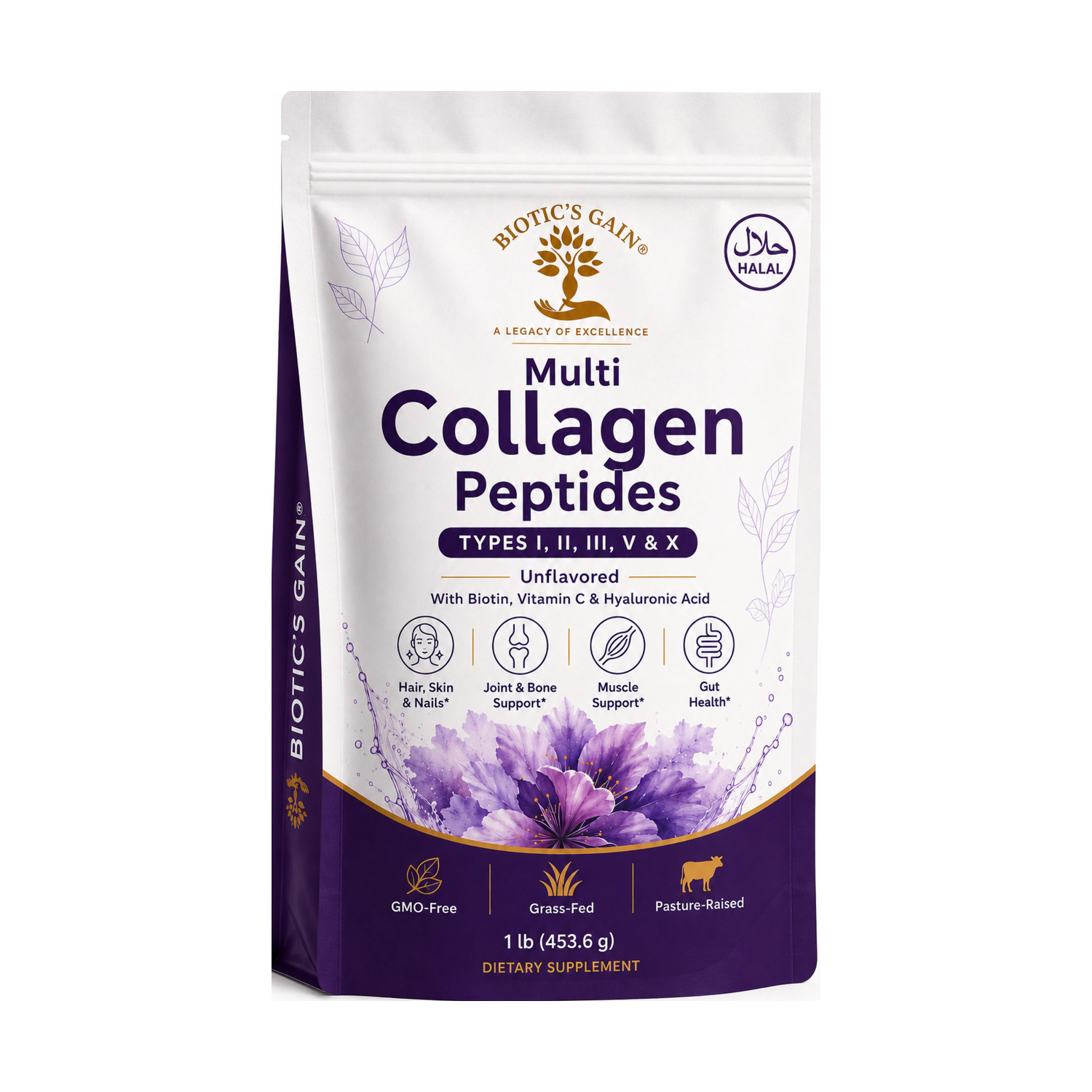
Collagen is a protein, but it is not the same kind of protein as whey. Collagen is built mostly from glycine, proline and hydroxyproline and contains very little tryptophan, which is why it is described as an incomplete protein. Whey isolate carries the full set of amino acids the body cannot make for itself. That difference matters in law as well as in biology: protein as a nutrient has authorised health claims in Great Britain, and those are the words Biotic’s Gain uses for its whey isolate. Collagen has no authorised claim of its own, so collagen is described in plain factual terms and nothing more.
Both are protein, but not the same protein
Protein is not one substance. It is a category, and what separates one protein from another is the order and proportion of the amino acids inside it. Collagen and whey sit at opposite ends of that range, which is why putting them side by side is more useful than arguing about which is “better”.
Collagen is the structural protein your body uses to build things that need to hold their shape: skin, tendon, ligament, bone matrix, cartilage, the walls of blood vessels. It is the most abundant protein in the body by weight. Its molecules are long triple helices wound together like rope, which is exactly what you want in a material whose job is to resist being pulled apart.
Whey is not structural at all. It is the protein fraction that stays in the liquid when milk separates during cheesemaking, and its amino acid make-up is nutritional rather than architectural. We covered where collagen ends up after you swallow it in what actually happens to collagen when you swallow it: both proteins are broken down into amino acids and short peptides before anything is absorbed.
Why collagen is called an incomplete protein
There are twenty amino acids in human protein, and nine of them are classed as essential, meaning the body cannot build them and has to get them from food. A protein that supplies all nine in reasonable proportion is called complete. One that is short of any of them is called incomplete.
Collagen is incomplete, and not marginally so. Roughly a third of its amino acid residues are glycine, with proline and hydroxyproline making up a large share of the rest. Tryptophan, one of the nine essentials, is effectively absent. That is a description of what collagen is, not a criticism of it. A material designed to be strong and flexible does not need a balanced nutritional profile, and evolution did not give it one.
Whey isolate is complete, and it is unusually rich in the branched-chain amino acids, leucine in particular. So the practical consequence is simple: a scoop of collagen and a scoop of whey isolate might both say “protein” on the front of the tub, but they deliver quite different mixes of raw material. Swapping one for the other is not a like-for-like trade.
What the rules allow anyone to say about protein
Great Britain keeps a register of authorised nutrition and health claims. If a claim is on it, you may use the authorised wording. If it is not, you may not use it at all, however reasonable it sounds. For protein there are three claims in everyday use, and this is how they read:
- Protein contributes to a growth in muscle mass
- Protein contributes to the maintenance of muscle mass
- Protein contributes to the maintenance of normal bones
Three details are worth noticing. The claims attach to the nutrient, protein, and not to any particular brand or formulation. They come with a condition of use: the food has to qualify as a source of protein, which means at least 12% of its energy comes from protein, a bar a whey isolate clears without effort. And the word “normal” in the third claim cannot be dropped or upgraded to something stronger. You will occasionally see “improves bone strength” on a label somewhere. That is not the authorised wording, and the difference is not decorative.
There is no authorised claim specific to whey. The register lists a long run of whey-specific claims that were assessed and rejected, so a whey product rides on the generic protein wording above or it says nothing. There is more on this on the protein topic page.
And what nobody is allowed to say about collagen
Collagen has no authorised health claim of its own anywhere in the register. Four collagen claims were put forward and turned down, including claims about the function of joints and about skin firmness and elasticity. Rejected is a stronger status than merely unproven: those exact ideas were assessed and did not pass, so nobody selling into Great Britain may put them on a label, a website or a social post.
The only authorised wording anywhere near the subject belongs to vitamin C, which has a claim about contributing to normal collagen formation. That claim is vitamin C’s, and it can only be used by a product that actually contains vitamin C in a meaningful amount. It is not a back door for a collagen powder.
So when you read a collagen page here, you will find what it is, where it comes from, how it is processed and how people fit it into a day, and you will not find a promise about what it will do. That is deliberate. The guide to collagen peptides covers sourcing, types and label reading in more detail.
Can you take both?
They are foods, and there is no reason they cannot sit in the same week. The sensible way to think about it is bookkeeping. If you are tracking a daily protein target, count the protein from a collagen serving honestly, but do not count it as though it were a complete protein. The amino acid profile is skewed, and the tryptophan is not there to be counted.
In practice they tend to be used at different moments anyway. Collagen powder is usually unflavoured and dissolves into coffee, porridge or a smoothie without announcing itself. Whey isolate is the one people reach for when they want a shake that stands on its own.
Reading either label without being sold to
The same handful of checks works for both tubs.
- Find the serving size before you read the protein figure. A generous-looking number attached to a 40g scoop is a different proposition from the same number on 25g.
- Read the ingredients list in order. It is ranked by weight, so anything after the flavouring is present in small amounts.
- Check the allergens. Whey is a milk product. Marine collagen comes from fish, bovine collagen from cattle.
- Look at the claims. Wording that sticks to “contributes to” and keeps the word “normal” is wording that has been checked. Wording that promises a result has not.
The short answer
Collagen is a protein supplement in the literal sense that it supplies protein, and it is not a protein supplement in the sense most people mean, which is a complete protein used to hit a daily target. Whey isolate is the one that does that job, and it is the one with authorised wording behind it. Collagen is bought for different reasons, and the honest thing a brand can do is tell you exactly what it is and leave the promises out.
Related reading
Biotic’s Gain supplements are food supplements and are not intended to diagnose, treat, cure or prevent any condition. A food supplement is not a substitute for a varied and balanced diet or a healthy lifestyle. If you are pregnant, breastfeeding, taking medication or under medical care, speak to your doctor or pharmacist before starting anything new.


Leave a Reply