
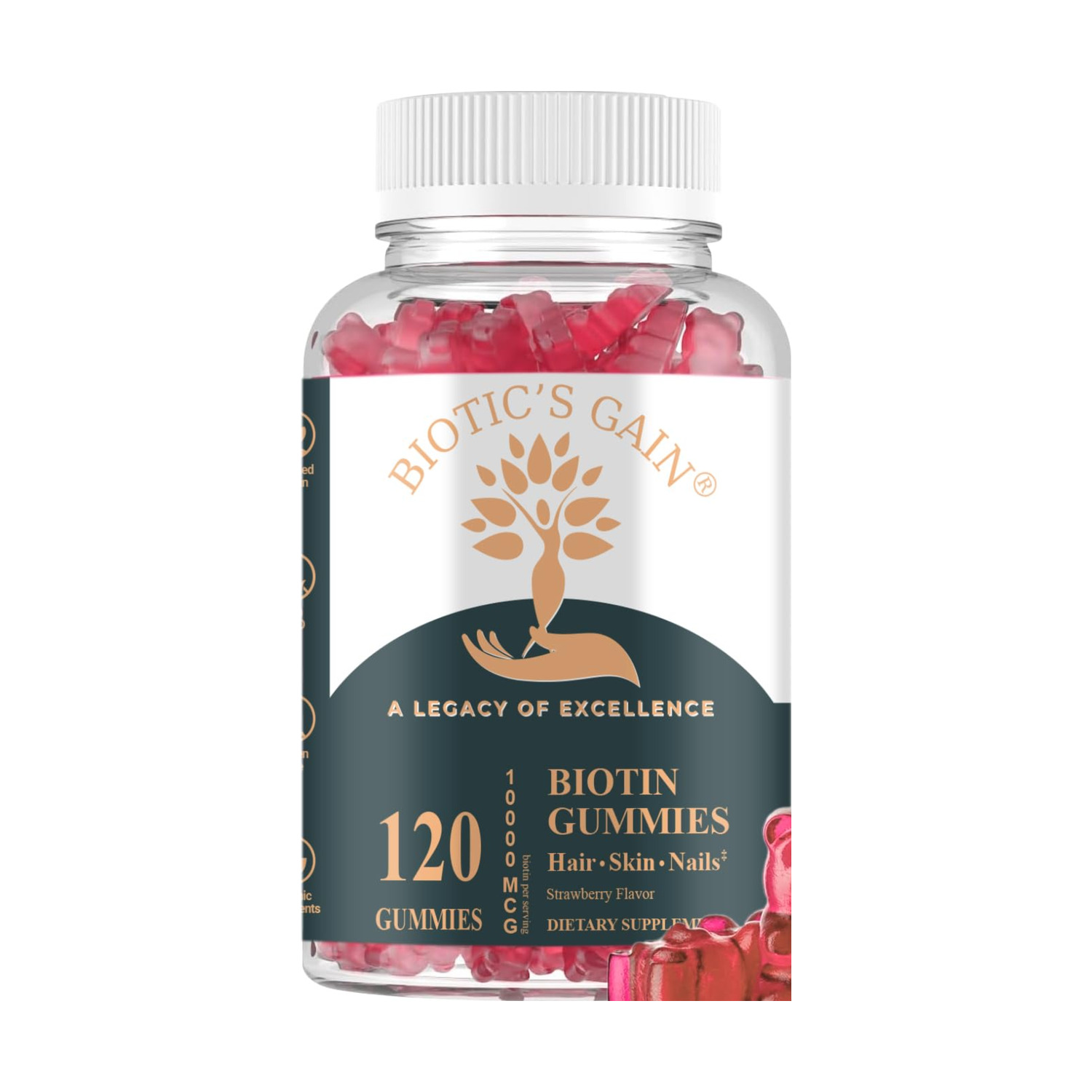
Because there is no legally set dose for most supplement ingredients in Great Britain. A label has to declare how much of a nutrient a serving contains, and for vitamins and minerals it has to show that amount against the Nutrient Reference Value, but the law does not tell a brand which amount to choose. Two biotin products can sit side by side at 50 micrograms and 10,000 micrograms and both be perfectly legal. The number reflects the format, the cost, what the brand thinks buyers expect and, often, what competitors are printing. A higher figure is a statement about contents, not about effect — and no supplement is allowed to claim that its dose works better than anyone else’s.
There is no legal dose, only a declared one
It helps to know what supplement labelling rules are for. They exist so you can see what is in the tub and so that nothing in it is unsafe: they govern declaration, not prescription. A brand must state the amount of each nutrient in its recommended daily portion, and for vitamins and minerals express that as a percentage of the Nutrient Reference Value. Nothing in any of it requires the amount to be a particular size.
That explains most of the variation on a shelf, and it explains why the percentages look so odd. An NRV is a comparison scale, not a target you are meant to hit or a ceiling you are meant to stay under. A figure of 20,000% next to a nutrient is not a claim about anything. It is arithmetic.
Where the reference numbers come from in the first place
Some nutrients have a UK intake recommendation and some do not, and biotin is the second kind. When the Committee on Medical Aspects of Food and Nutrition Policy looked, there was not enough evidence to set a requirement, so it gave a “safe and adequate” range of roughly 10 to 200 micrograms a day instead. The NRV used for labelling is 50 micrograms. A product supplying 10,000 micrograms sits far above both — the number was not derived from a requirement, because there is none to derive it from.
Protein does have a reference figure — the UK RNI of 0.75g per kilogram a day — but even that is a population minimum, and scoop sizes still vary. How much protein you actually need in a day covers it.
What a brand is really deciding when it picks a number
- Format. A gummy carries flavour, pectin or gelatine and bulk, so it has less room than a capsule, and a powder holds far more than either. The format sets a practical ceiling before anyone has argued about the dose.
- Cost per gram. Biotin is cheap, so a large number costs a brand very little. Marine collagen is expensive by weight, which is why collagen serving sizes cluster so tightly across the whole market.
- What buyers read as value. People compare the biggest number on two boxes, and brands know it. Much of the inflation is simply an answer to the last competitor who inflated theirs.
- Safety headroom. Where an upper level is established, the amount must sit sensibly below it. Where none is, the constraint is looser — and that is exactly where the widest variation appears.
Why a bigger number cannot be sold as a better result
Here the law does bite. Only claims authorised on the Great Britain nutrition and health claims register may be used here. For biotin there are seven, and these are the exact permitted wordings:
- Biotin contributes to normal energy-yielding metabolism
- Biotin contributes to normal macronutrient metabolism
- Biotin contributes to the normal functioning of the nervous system
- Biotin contributes to normal psychological function
- Biotin contributes to the maintenance of normal hair
- Biotin contributes to the maintenance of normal skin
- Biotin contributes to the maintenance of normal mucous membranes
Notice what is missing. Not one mentions a dose, absorption, or one product against another. The claims attach to the nutrient rather than the formulation, and they are conditional on the food being at least a source of biotin. “Works better” is not a phrase anyone in this market may use, whatever their label says.
The word “normal” is load-bearing in every one of those sentences. It cannot be dropped and it cannot be traded up: “maintenance of normal hair” is authorised, thicker or faster-growing hair is not. There is also no authorised nails claim in GB — “necessary for healthy teeth, bones, hair, skin and nails” is specifically non-authorised — so we make none. What biotin actually does sets that out in full.
Collagen is stricter still: no authorised claim of its own, and four proposed ones — including joint function and skin firmness and elasticity — sit on the rejected list, assessed and turned down. The only authorised claim that mentions collagen belongs to vitamin C: “Vitamin C contributes to normal collagen formation for the normal function of blood vessels, bones, cartilage, gums, skin and teeth.” That is a vitamin C claim, conditional on the food qualifying as a source of vitamin C, and not a back door for a collagen powder.
Which makes the dosing arms race look a little silly. Clear the source-of-biotin threshold and you may use the claim; clear it a hundred times over and you may use exactly the same claim, because there is no stronger one to earn.
How to compare two labels without being led by the big number
- Find the serving size first. 10,000mcg across two gummies is not the same offer as 10,000mcg in one. Work everything back to one day’s recommended portion.
- Check per serving against per 100g. Powders often show both, and the per-100g column is the flattering one.
- Count servings, not grams. A bigger tub at a bigger serving size can be fewer days. Price per day is the comparison that means something.
- Read the rest of the list. A long line-up of nutrients at token amounts is a different proposition from a short one at meaningful amounts.
- Stick to the stated daily portion. It is what the product was formulated and labelled around, and doubling it is a shortcut to nothing.
Our own biotin gummies state 10,000mcg in the daily portion, exactly as a tub of whey isolate states 25g of protein per serving. Both are descriptions of contents, not promises, and we are careful not to dress them up as one. What ‘bioavailability’ actually means covers the other half of the question.
When it is worth asking someone rather than a label
A pharmacist is the easiest person to ask and needs no appointment. Worth doing if you take prescription medicines, if you are pregnant or breastfeeding, if several supplements you take might overlap, or if you are about to have blood taken — high biotin intakes are known to interfere with some laboratory assays, so tell whoever runs the test what you take. Speak to a GP about hair loss that comes on suddenly, in patches, or with scalp symptoms. No food supplement can treat, prevent or cure any condition, and that sentence is worth more than a big number on a box.
You can find the rest of our plain-English explainers on the thinning hair and collagen topic pages.
Related reading
Biotic’s Gain supplements are food supplements. They are not a substitute for a varied and balanced diet or a healthy lifestyle, and no food supplement can treat, prevent or cure any condition. Do not exceed the recommended daily portion. If you are pregnant, breastfeeding, taking medication or under medical care, speak to a pharmacist or GP first.

Leave a Reply