
On pre-packed food sold in Great Britain, the fourteen recognised allergens must be named in the ingredients list whenever they are part of the recipe, and emphasised so they stand out — usually in bold. “May contain” is a different sort of statement entirely. It is voluntary, it sits outside the ingredients list, and it describes the possibility that traces have carried over from other products made on the same equipment. No legal threshold sits behind it, so one manufacturer’s warning and another’s silence do not reliably mean different things. Read the ingredients list for what is actually in the food, and read a precautionary warning as the manufacturer saying they cannot rule something out.
The fourteen allergens, and where they have to appear
Great Britain recognises fourteen allergens in food law, and the list is fixed rather than a matter of judgement: celery, cereals containing gluten, crustaceans, eggs, fish, lupin, milk, molluscs, mustard, peanuts, sesame, soybeans, tree nuts, and sulphur dioxide and sulphites above ten milligrams per kilogram or litre.
On pre-packed food, any of those present in the recipe has to be named in the ingredients list and emphasised, which in practice means bold, capitals, italics or a different colour. A separate “allergy advice” box is no longer the mechanism, so a pack with a box and no emphasis in the list is doing it the old way. The allergen also has to appear in plain words: a label cannot leave milk sitting behind “casein” alone, or egg behind “albumen”, without the everyday word appearing alongside it.
This part of the law is not optional and does not depend on quantity. An ingredient contributing a fraction of a per cent still has to be declared and emphasised. That is what makes the ingredients list the authoritative part of the pack, and everything printed around it secondary.
Why “may contain” is a different kind of statement
Precautionary wording — “may contain”, “not suitable for”, “made in a factory that also handles” — is voluntary. No law sets a threshold at which it becomes required, and no law sets the words. That explains the inconsistency people notice on the shelf: two products made in broadly comparable conditions can carry completely different warnings, because each manufacturer has assessed its own lines and its own cleaning.
It is a statement about the factory rather than about the recipe. What it describes is cross-contact: shared equipment, shared handling, dust carried over from a previous batch. It is not a quantity and should not be read as one. “May contain traces” is not a milder version of “may contain” — the phrasing varies by house style, not by degree of risk.
The practical consequence runs the other way too: the absence of a precautionary warning is not a guarantee of absence. Anyone avoiding an allergen on a clinician’s advice needs the ingredients list first and, where the stakes are high, the manufacturer’s own answer second — most have a customer care line and will say what else runs on the same equipment. Recipes are also reformulated often, which is why a label worth checking once is worth checking again when the packaging changes.
Reading the ingredients list itself
Ingredients are listed in descending order of weight as they went into the mix, which tells you more about a product than any front-of-pack figure does. If sugar is third in a list of twelve, that is the recipe telling on itself. Added water counts, and has to be declared when it makes up more than five per cent of the finished food.
Compound ingredients are broken open in brackets. “Sponge (wheat flour, sugar, egg, raising agent)” is a single line of the main list carrying its own sub-list, and allergens inside the bracket are emphasised in exactly the same way as those outside it.
Percentages turn up when an ingredient is named in the product name, pictured, or emphasised on the front of the pack. That is the quantitative declaration, and it is why a chicken and mushroom pie has to say how much chicken is in it — a useful corrective to a generous photograph.
Additives appear either by name or by E number, with the function stated first: “preservative: sodium nitrite”, “colour: E150d”. Neither form is a verdict on the ingredient. Flavourings may be declared collectively as “flavourings”, which is permitted and is why the list on a flavoured product is often shorter than people expect. What actually sits in a finished product alongside the thing you bought it for is covered in what else is in a protein powder and in what biotin gummies are made of.
Food that is not pre-packed
The rules change with the way the food is sold. Pre-packed food, sealed before you choose it, carries the full ingredients list described above.
Food packed on the premises where it is sold — the sandwich made that morning and put in the chiller — is prepacked for direct sale, and since the law changed in 2021 it has had to carry a full ingredients list with allergens emphasised, on the pack itself.
Food that is genuinely loose, served at a counter or plated in a restaurant, needs no printed list, but the allergen information still has to be available: either written down or given by staff, with clear signposting telling you to ask. A counter with no notice and a menu that says nothing is not compliant. Asking in person is worth doing even where something is written, because a written answer describes the recipe rather than the kitchen it was assembled in.
A practical order to read a new pack in
- Ingredients list first. It is the only part that has to be complete and accurate about what is in the food.
- Look for emphasis, not for a box. Bold, capitals or colour inside the list is where allergens are now declared.
- Open the brackets. Compound ingredients hide the most, and that is where an unexpected allergen usually turns up.
- Then the precautionary line, read for what it is. A statement about shared equipment, with no threshold behind it.
- Re-read after a packaging change. New artwork is the commonest sign that something in the recipe moved.
- Front of pack last. The colours and the figures there answer a different question, set out in what the traffic light colours mean.
What claim wording on a pack has to follow
Separately from allergens, anything a label says about what a nutrient does is tightly controlled. In Great Britain only wording authorised on the nutrition and health claims register may be used, the claim belongs to the nutrient rather than to the brand, and the food has to contain enough of that nutrient to qualify. Biotin has seven authorised claims, and these two are the ones people usually arrive looking for, in their exact permitted form:
- Biotin contributes to the maintenance of normal hair
- Biotin contributes to the maintenance of normal skin
The word “normal” carries both of those sentences. It cannot be dropped and it cannot be traded up: maintenance of normal hair is authorised, while thicker, stronger or faster-growing hair is not. There is no authorised nails claim in Great Britain, so we make none, however often one turns up on a label elsewhere. We quote no claim wording for any other nutrient named on this page either, because we only quote wording we have checked against the Great Britain register ourselves. What biotin actually does, and what it isn’t allowed to claim sets out the full position, and our other plain-English explainers sit on the thinning hair topic page.
When it is worth asking a pharmacist or GP
- Before cutting a whole food group out of your diet, so you know what that leaves out
- If you have been given specific dietary advice, where a general labelling rule of thumb may not apply to you
- Before starting anything new if you are pregnant, breastfeeding, taking prescription medicines or under medical care
- For any reaction to a food, which is a conversation with a clinician rather than a label-reading exercise
Where the Biotin Gummies sit
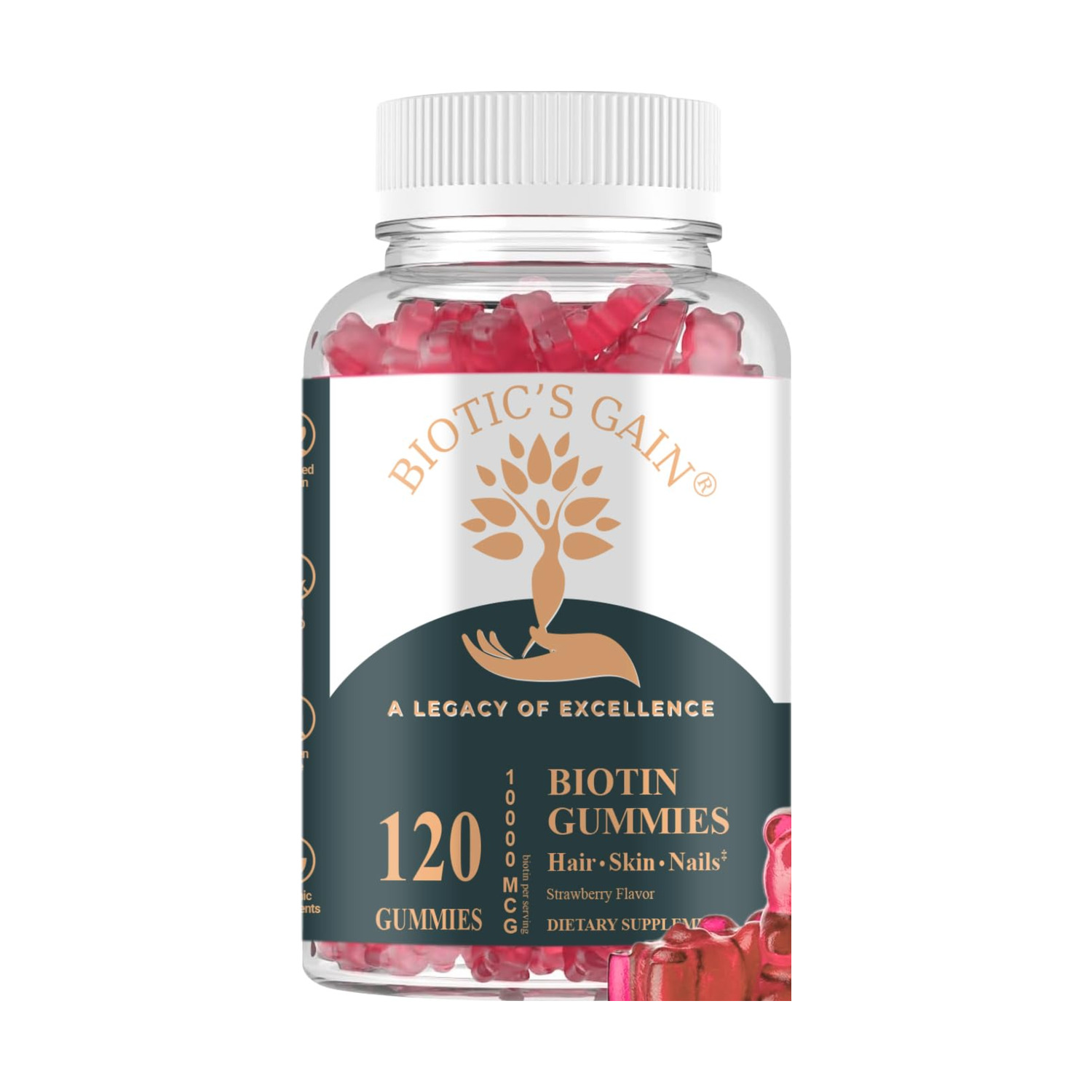
Biotic’s Gain Biotin Gummies are a food supplement, and a supplement jar is read exactly the way a food pack is: ingredients in descending order of weight, allergens emphasised in the list, the daily portion stated so the figures beside it mean something. The amount of biotin in that portion describes what is in the product — it is a description rather than a promise. If the base, the sweetener, the gelatine or an allergen matters to you, the ingredients list on the jar is the authority, not the front of the label and not a product page.
One practical point worth repeating on any page about labels: high biotin intakes are known to interfere with some laboratory assays, so tell whoever runs the test what you take if you are having blood taken.
Related reading
Biotic’s Gain supplements are food supplements. They are not a substitute for a varied and balanced diet or a healthy lifestyle, and no food supplement can treat, prevent or cure any condition. Do not exceed the recommended daily portion. If you are pregnant, breastfeeding, taking medication or under medical care, speak to a pharmacist or GP first.

Leave a Reply