
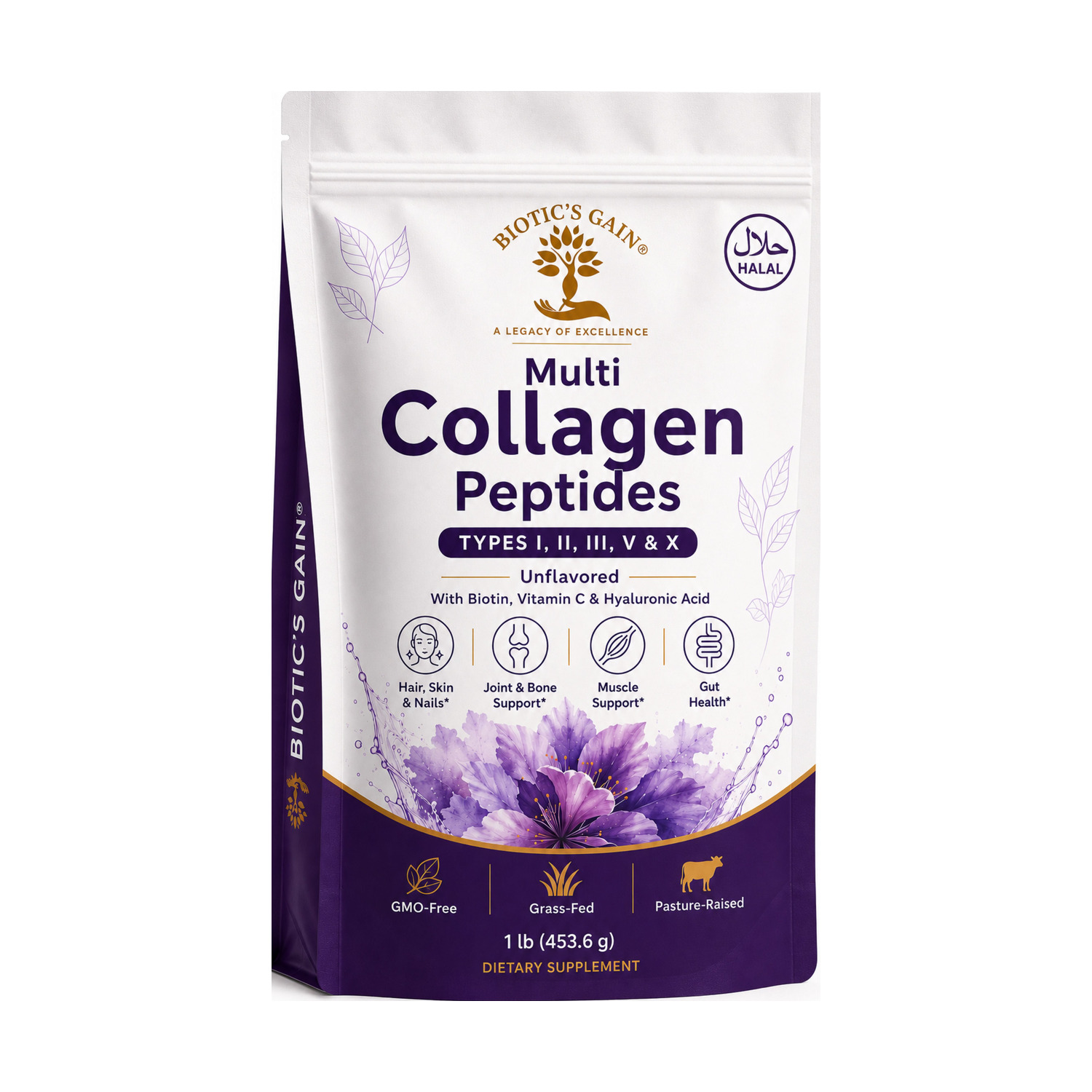
Most collagen supplements list their contents as Roman numerals and leave it there. Type I, III, V, X. It reads like a specification sheet, and almost nobody explains what any of it means.
It’s worth understanding, because the numerals are a description of structure: they tell you which kind of collagen is in the tub and where that kind occurs naturally in the body.
Collagen isn’t one substance
Collagen is the most abundant protein in the body and there are around 28 identified types. Five appear in supplements with any regularity, because those five make up the overwhelming majority of what’s actually in human tissue. One thing to say plainly before we go any further: there is no authorised health claim for collagen in Great Britain, so we describe what is in the tub rather than what it does. The only adjacent authorised wording belongs to vitamin C, and it reads exactly like this: vitamin C contributes to normal collagen formation for the normal function of blood vessels, bones, cartilage, gums, skin and teeth. That claim can only be made where the product actually contains vitamin C.
The types you’ll see on a label
Type I is the most abundant of the lot. It accounts for roughly 90% of the collagen in the human body and occurs in skin, tendons, bone and hair. In supplements it is usually sourced from bovine hide or from fish skin and scales, which is what “marine collagen” on a label normally means.
Type II occurs in cartilage rather than in skin. It is structurally different enough from Type I that it has to be sourced separately, most often from chicken sternum cartilage rather than from bovine or marine material.
Type III sits alongside Type I in skin and in blood vessels, and the two are usually found together in the same tissue. In practice it tends to be present wherever Type I is, which is why bovine and marine sources supply both at once.
Type V occurs in much smaller quantities. Structurally it is a regulatory collagen: it is part of how Type I and Type III fibres are assembled in tissue. Less glamorous on a label, and present in small amounts in most bovine-sourced blends.
Type X occurs in cartilage and in bone tissue rather than in skin. Like Type II it comes from cartilage sources, so a blend listing Type X is usually one that includes a chicken-derived ingredient.
Why “peptides” matters
“Peptides” is a processing description rather than a claim. Whole collagen is a very large molecule. Hydrolysed collagen, sold as collagen peptides, has been broken down by enzymes into much shorter chains of amino acids. The difference you can see for yourself is in the glass: peptides disperse into a drink without clumping, while unhydrolysed collagen tends not to.
What a blend contains
A single-type product contains one type of collagen, usually from one source. A multi collagen blend contains several types in one serving, which means one tub and one daily habit rather than two or three separate products to buy and remember. That is a practical and commercial difference, not a health one: what is in the tub is what we are able to tell you about, because there is no authorised collagen claim in Great Britain to make.
Setting expectations
Here is where a lot of collagen marketing gets carried away, so we will be blunt instead. We are not going to tell you what collagen will do, because in Great Britain there is no authorised health claim for collagen and we are not in the business of inventing one. What we can tell you is what is in the tub: hydrolysed collagen peptides, the types listed on the label, the source they came from, and nothing else pretending to be a shortcut. If you want wording with a regulator behind it, look for vitamin C on an ingredients list, because vitamin C contributes to normal collagen formation for the normal function of blood vessels, bones, cartilage, gums, skin and teeth. Beyond that, collagen is a daily habit and the tub is sized on that basis. If you are taking it because of a specific health concern, talk to your GP or a registered dietitian rather than to a supplement label.
Biotic’s Gain products are food supplements and are not a substitute for a varied, balanced diet or a healthy lifestyle. Nothing here is medical advice. If you have a health condition, are pregnant or breastfeeding, or are taking medication, speak to a pharmacist or your GP before starting a supplement.

Leave a Reply