
Bioavailability describes how much of a nutrient actually reaches your bloodstream in a usable form, rather than how much went into the capsule in the first place. A label can only tell you the second thing. Between swallowing and circulation, a nutrient has to be released from its carrier, survive stomach acid, cross the gut wall and pass through the liver, and a share of it is lost at every stage. That loss is ordinary, and it is one reason supplement doses are often far larger than the amount the body actually needs. Bioavailability is a description of absorption, not a grade of quality, and no absorption figure is a claim about what a product will do for you.
Where the word comes from
Bioavailability began as a pharmacology term with a precise meaning: the fraction of a dose that reaches the general circulation unchanged. An injection into a vein is 100% by definition; anything swallowed is less.
Nutrition borrowed the word and used it loosely. There is no single agreed way to measure it for a vitamin — one study tracks blood concentration, another what turns up in urine, another a marker in tissue, and they do not always agree. So “highly bioavailable” on a pack, with no comparison and no method, is closer to an adjective than a measurement.
What happens between the tablet and your bloodstream
The sequence is much the same whatever the format. The tablet, gummy or powder has to break apart and dissolve. The nutrient then crosses the lining of the gut, mostly in the small intestine, either passively or carried by a transporter protein, and travels in the blood to the liver, which processes a share of it before the rest goes out to the body. Whatever is not absorbed leaves in the stool.
Two details there explain most of the confusion about doses. Transporters saturate: where a nutrient relies on an active carrier, ten times the dose does not get ten times as much across, and the percentage absorbed falls as the dose rises. And water-soluble nutrients are barely stored, so the surplus is filtered out by the kidneys, while the fat-soluble ones — A, D, E and K — need some dietary fat present and are held in the body.
Why the big number on the front is not the number that reaches you
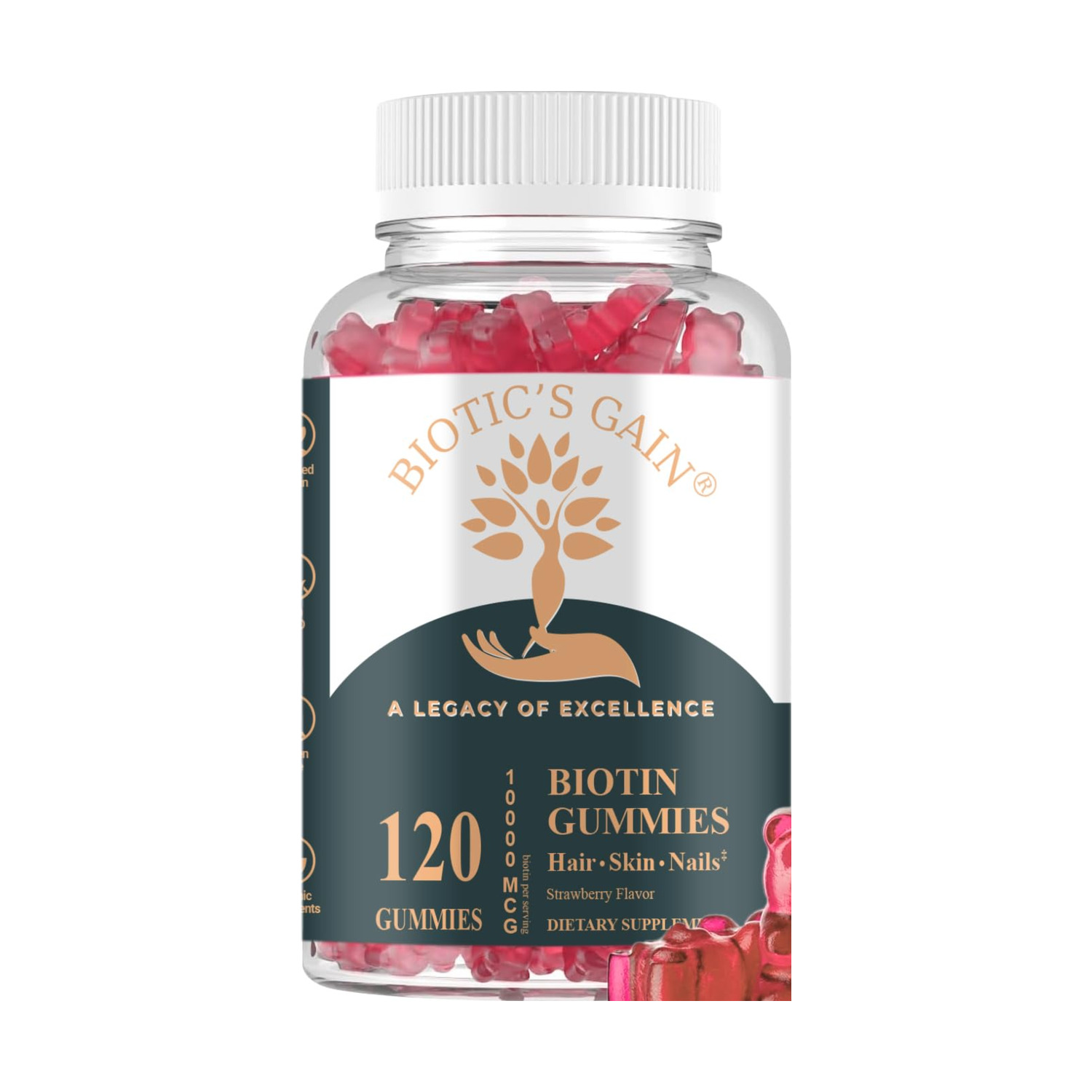
A high-strength biotin product is a clear example. Our own gummies supply 10,000 micrograms per daily serving, and that figure describes what is in the gummy — not how much crosses the gut wall, and not how much a person needs. The UK has never set a reference nutrient intake for biotin; the long-standing COMA advice was that intakes between 10 and 200 micrograms a day are safe and adequate. Everyday food contributes quietly, as where biotin comes from in food sets out.
A high-strength dose, then, is not there because the body uses all of it. It is there because absorption is incomplete, biotin has a wide margin of safety, and one daily dose is easy to remember.
What genuinely changes how much is absorbed
- Whether you take it with food. Fat-soluble nutrients do better with a meal containing some fat. If a pack says which, follow it.
- The chemical form. Minerals vary most: iron from meat is absorbed more readily than iron from plants, and magnesium salts dissolve to different degrees. A factual detail, not a promise.
- What else is in the mouthful. Calcium and iron compete for the same route across the gut wall, and tea reduces iron absorption from a meal. Spacing things out often beats switching products.
- The size of the dose. Because carriers saturate, a very large dose is absorbed less efficiently, proportionally, than a moderate one.
- You. Age, digestive conditions and some prescribed medicines change absorption — a conversation for a pharmacist or GP.
Format matters less than the marketing suggests: once a gummy, tablet or powder has dissolved, the nutrient is in the same solution either way, so format is mostly about what you will keep taking, as how much biotin you need in a day discusses.
What may legally be said about biotin — and what may not
In Great Britain only claims on the GB nutrition and health claims register may be used, in the authorised wording. Biotin has seven, and this is the complete list:
- Biotin contributes to normal energy-yielding metabolism
- Biotin contributes to normal macronutrient metabolism
- Biotin contributes to the normal functioning of the nervous system
- Biotin contributes to normal psychological function
- Biotin contributes to the maintenance of normal hair
- Biotin contributes to the maintenance of normal skin
- Biotin contributes to the maintenance of normal mucous membranes
Every one is conditional on the food being at least a source of biotin, and the word “normal” is load-bearing. It cannot be dropped and it cannot be traded up: “maintenance of normal hair” is authorised, thicker or faster-growing hair is not. The claims attach to the nutrient rather than a formulation, so they say as much about biotin in an egg as biotin in a gummy.
There is no authorised nails claim for biotin in Great Britain. The familiar phrase “necessary for healthy teeth, bones, hair, skin and nails” is specifically on the non-authorised list, which is why it appears nowhere on this site. Nor is anything in the register a claim about absorption: no product may say that being better absorbed makes it work better, because “works better” is not a claim anyone may make. What biotin actually does goes through this in more detail.
Collagen is where the absorption argument usually starts
Collagen powders carry the heaviest absorption language, partly because collagen has no authorised health claim of its own to fall back on. Four proposed collagen claims sit on the rejected list, including ones about joint function and about skin firmness and elasticity, so those cannot be made in any wording. The only authorised claim in this territory belongs to a vitamin: “Vitamin C contributes to normal collagen formation for the normal function of blood vessels, bones, cartilage, gums, skin and teeth.” That is a vitamin C claim, conditional on the food qualifying as a source of vitamin C, and not a back door to a collagen claim.
The digestion side is simply factual: collagen is a protein, and swallowed protein is broken into peptides and amino acids before anything is absorbed, as what happens to collagen when you swallow it explains. Hydrolysed collagen is cut into shorter fragments already — processing, not permission to claim a result.
Reading the front of the pack more calmly
Words like activated, chelated, liposomal or micronised describe real chemical differences. Whether the difference matters for you, at that dose, is a separate question the pack rarely answers. Two questions cut through it: compared with what, and measured how. If neither is stated, treat the word as packaging.
What is worth reading is duller. How much of the nutrient is in one stated daily serving. Which form it is in, named. Whether you are told to take it with food. Whether the claims use the authorised wording or something grander. And whether the routine is one you will still be following in three months — with hair and skin, that is what genuinely differs between people. There is more in our thinning hair guide.
Related reading
Biotic’s Gain human products are food supplements. They are not a substitute for a varied, balanced diet and a healthy lifestyle, and no food supplement can treat, prevent or cure any condition. If you are pregnant or breastfeeding, taking prescribed medicines, or have an ongoing health concern, speak to your GP or pharmacist first.

Leave a Reply