

Most adult dogs sleep for somewhere between 12 and 14 hours out of every 24, and plenty sleep more than that without anything being wrong. Puppies commonly need 18 to 20 hours, and older dogs usually drift back up towards that as well. Dogs also sleep quite differently from us: in short bouts spread across the day and night rather than one long block, with lighter, more easily broken sleep. So a dog who dozes through most of the afternoon is behaving normally, not going flat. The useful question is not how many hours, but whether the sleep is broken and whether the pattern has changed for that particular dog.
How much is normal, by age
- Puppies: roughly 18 to 20 hours a day, taken in frequent naps. Growing, learning and the sheer effort of a new world all use it up, and an overtired puppy usually becomes more bitey and less biddable, not sleepier.
- Adult dogs: around 12 to 14 hours, most of it overnight with long stretches of dozing in the day.
- Older dogs: often 16 hours or more, with the extra time coming in daytime naps rather than a longer night.
- Large and giant breeds: tend to sleep more than small ones of the same age, which is ordinary rather than a sign of anything.
Working dogs in a job, and dogs with a lot of daily activity, sometimes sleep less in total but sleep more solidly. A dog left alone in a quiet house all day will often clock up hours that look impressive and mean very little, because much of it is light dozing rather than deep rest.
Dogs sleep in bouts, not in blocks
Human sleep runs in cycles of roughly ninety minutes and we expect it in one long shift. A dog’s cycle is far shorter, and their pattern is closer to a series of naps — a spell of sleep, a brief wake, a reposition, and back under. That is why a dog can look deeply asleep and then be at the front door in a second, and why they seem able to sleep in the middle of a noisy kitchen.
One consequence is that dogs spend a smaller share of their sleep in the deep, restorative phases than we do, and they make up for it with more total hours. Another is that broken sleep costs them more than it costs us. A dog whose naps are interrupted twenty times a day by a doorbell, a delivery van or a household on the move is not getting the rest the hours suggest, and it tends to show up as a shorter fuse rather than obvious tiredness.
Where a dog sleeps changes how well they sleep
Most dogs choose a spot with their back or side against something, with a view of the room and the door. A bed in the middle of a thoroughfare gets used far less than one tucked into a corner of the same room. If your dog keeps abandoning an expensive bed for the hall floor, the location is usually the problem before the bed is.
- Support matters more with age. A thin bed on a hard floor is fine for a two-year-old and less comfortable for a twelve-year-old with stiffening joints. Older dogs often shuffle between several spots in a night looking for a position that suits.
- Temperature beats padding. Dogs overheat more easily than we do. A thick bed next to a radiator gets rejected in winter; a cool tiled floor is a deliberate choice, not a snub.
- Light and noise. A hall light left on, a television through a wall, or a window onto a street with foot traffic will all keep a dog in shallow sleep.
- Company. Many dogs settle better in the same room as their people, or within earshot of them. Some prefer to be alone entirely. Both are normal, and it is worth finding out which yours is rather than deciding for them.
What disturbs sleep in an ordinary household
The common culprits are dull. A last walk that turns into a high-energy game leaves a dog wound up rather than tired. Feeding very late can mean a toilet trip at three in the morning, and feeding too early can mean a dog awake and expecting breakfast before dawn — the sequence of the evening matters more to a dog than the clock does, which is the subject of whether it matters what time you feed your dog. Visitors, building work next door, a new baby, a house move or a change of shift pattern all show up in sleep before they show up anywhere else.
A settled routine does most of the work. A predictable wind-down — last toilet trip, lights down, the same place to sleep — tells a dog the day is finished far more reliably than a fixed bedtime does. The same principles that help an unsettled dog in the evening are covered in what actually settles an anxious dog, and there is more general background on our anxiety guide and older dogs guide.
Where our chews fit — and what they are not
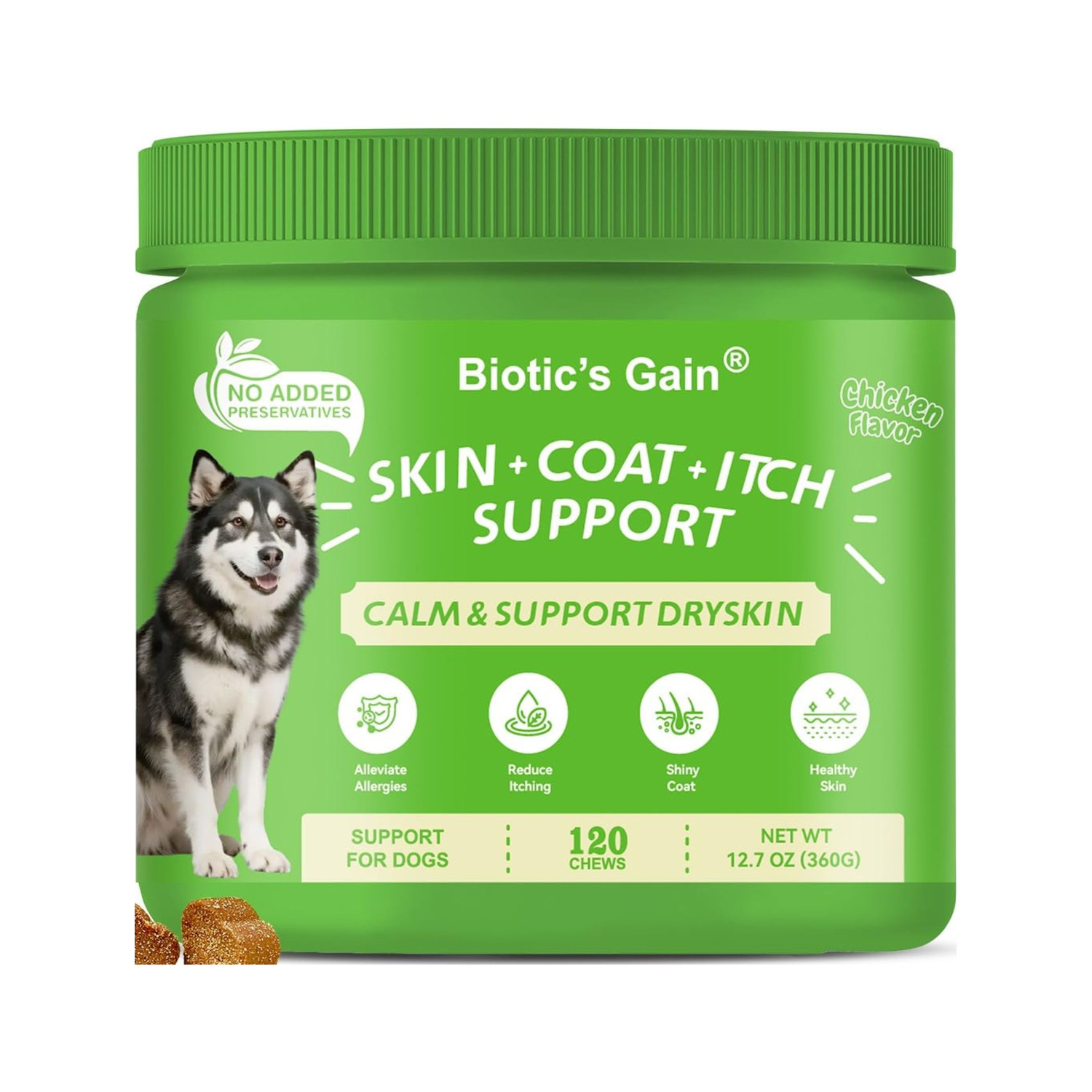
Biotic’s Gain Calming Chews are a complementary feed for dogs, made with L-theanine, an amino acid found naturally in tea leaves, with 120 soft chews in a tub. They are fed alongside a complete, balanced diet, to the guide on the pack, which is sized by the dog’s weight.
That is a description of the product and nothing more. A complementary feed cannot claim to treat, prevent or cure anything, and that includes disturbed sleep — so we do not say it does. If a dog is not sleeping, the things worth changing first are the bed, the location, the evening routine and the amount of daytime activity, and none of those come out of a tub.
When to speak to your vet
A change in sleep is one of the earliest things owners notice, and it is worth taking seriously rather than waiting to see. Book an appointment if your dog:
- paces, circles or cannot settle at night, particularly if this is new
- pants heavily while resting, or struggles to get comfortable in any position
- is suddenly sleeping much more, or much less, than has been usual for them
- has difficulty getting up, or cries out when changing position
- snores loudly for the first time, breathes noisily at rest, or seems to pause in their breathing while asleep
- seems confused or disoriented at night, especially an older dog
- has started waking to go to the toilet when they previously slept through
Your vet is the right person for any of that. It is also worth mentioning a change in sleep at a routine check-up even when nothing else seems different, because you are the one who knows what normal looks like for your dog.
Related reading
Biotic’s Gain chews are a complementary feed for dogs, fed alongside a complete, balanced diet. A complementary feed cannot treat, prevent or cure any condition. If you have any concern about your dog’s health, sleep or behaviour, speak to your vet.


Leave a Reply