

Once a week suits most dogs, and it takes well under a minute. You are looking rather than cleaning: lift each ear flap and look at the skin underneath, have a quick sniff, then look at both eyes in good light and check they are clear, equally open and free of anything crusted in the corners. Dogs with heavy drop ears, dogs who swim and dogs with wrinkled faces are worth checking more often than that. Nothing goes down an ear canal — no cotton buds, no water, no drops unless your vet has prescribed them — and anything sore, smelly, or changed since last week is a phone call to the vet rather than something to sort out at home.
What the weekly check is actually for
The point of looking every week is not hygiene. It is that you build a reliable picture of what your own dog looks like when nothing is wrong, so a change registers immediately instead of a fortnight later. Ears and eyes are both areas where a problem can go from mild to miserable quickly, and both are areas where owners tend to notice only once the dog starts telling them — head shaking, scratching, a paw going up to the face.
It also sits naturally alongside the rest of the at-home once-over. If you are already looking in the mouth, as whether a dog needs their teeth brushed sets out, and running a hand down each leg to the feet, as in how to tell if your dog’s nails are too long, then ears and eyes are two more stops on the same route. Done as one habit it takes a couple of minutes a week in total, usually in front of the television.
What a healthy ear looks like
Lift the flap and the skin inside should look pale pink and dry, with no redness at the fold, no swelling and no visible debris. A small amount of pale wax is normal and does its job — wax carries dust and dead skin outwards, which is precisely why the canal does not need cleaning out.
Smell is the most useful single test and the one most people skip. A healthy ear smells of very little. A strong, yeasty or sour smell is the earliest reliable sign that something has changed, and it usually arrives before any visible mess does. The other things to note are heat, a flap your dog pulls away from when you touch it, and dark or sticky discharge of any colour.
Behaviour counts as part of the check. Repeated head shaking, scratching at one ear, rubbing the side of the head along the sofa, or holding the head slightly tilted to one side are all worth taking seriously even when the ear itself looks unremarkable, because a dog’s ear canal turns a corner and most of it is not visible from the outside.
Wiping the flap, and what never goes in the canal
- The visible flap only. A damp cotton pad or a soft cloth over the inside of the flap, as far as you can see and no further.
- Never a cotton bud. It pushes debris in rather than taking it out, and the canal is easy to damage.
- No water down the ear. A canal that stays damp is the one condition most likely to cause trouble.
- No household remedies. Vinegar, oils and surgical spirit all turn up in online advice and none of them belong in a dog’s ear.
- Only a product your vet has given you. Ear drops and cleaners are prescribed for a particular problem in a particular ear, and leftovers from last year are not a general-purpose bottle.
- Dry after swimming or a bath. Dab the flap and the entrance with a dry pad — the same thinking as drying a coat properly, which how often to bath a dog goes into.
Eyes: what normal looks like
In daylight or under a decent lamp, both eyes should look clear and glossy, the whites should be white rather than pink, and the two should match each other — same degree of openness, same size of pupil, same amount of moisture. A little clear or slightly brown-grey matter in the inner corner first thing in the morning is ordinary and wipes away with a damp pad, working outwards and using a separate pad for each eye.
What matters is asymmetry and change. One eye held half shut, one pupil larger than the other, cloudiness anywhere over the surface, a blue or hazy look, visible redness, yellow or green discharge, or a dog rubbing their face along the carpet all mean the eye is being told about rather than looked at. Eyes are the part of this check where waiting until the morning is the wrong instinct: a dog squinting or pawing at an eye is a same-day call to your vet.
Tear staining down the face is common in pale, small and flat-faced dogs and is often just moisture sitting on the fur. Keeping the area clean and dry with plain water is reasonable; a stain that suddenly appears or worsens on a dog who never had it is a reason to ask, because the tears are going somewhere they did not go before.
The dogs who need looking at more often
Shape and habits decide the frequency. Heavy drop-eared dogs — spaniels, retrievers, bassets — have less air moving through the canal, so twice a week is a fairer interval. Dogs who swim, or who are bathed often, want a look after each session rather than on a calendar. Dogs with hair growing in the ear opening, poodles and poodle crosses especially, hold more debris; ask your groomer what they do and whether anything needs doing between appointments.
Flat-faced and wrinkled dogs need the facial folds looked at along with the eyes, because the fold sits close to the eye itself and is both shallower and damper than it looks. Older dogs are worth checking on a fixed day of the week rather than when you remember, since changes in sight come on gradually and a dog compensates well enough to hide it at home; our guides for that stage sit on the older dogs topic page.
Getting a dog used to having their head handled
- Days one to three. Touch the base of an ear, let go, treat. Five repetitions and stop. Nothing is lifted or looked into this week.
- Days four to six. Lift the flap for two seconds, release, treat. Sit beside your dog rather than leaning over them.
- Days seven to nine. Lift, hold, and actually look. Add the sniff. Still nothing touching the ear.
- Days ten to twelve. Introduce the pad: let your dog sniff it, touch it to the flap, treat, put it away.
- Then the eyes. A thumb resting gently above the brow, lifting the lid area a fraction, one eye an evening.
- If it goes wrong, go back two steps. A dog who has had a sore ear handled firmly once will remember it, and rebuilding takes longer than the original training would have.
When to speak to your vet
- Any smell from an ear, or discharge of any colour or consistency
- Redness, heat or swelling inside the flap, or a flap your dog will not let you touch
- Repeated head shaking, scratching at one ear, or a head held tilted to one side
- Squinting, pawing at an eye, or a sudden change in how much either eye is open — same-day rather than next week
- Cloudiness, a blue or hazy look, visible redness, or coloured discharge from an eye
- Pupils that do not match, or a dog bumping into things, hesitating on steps or losing confidence in the dark
- Anything in either ear or eye that looks different from how it looked a week ago and you cannot account for
Where the 25-in-1 Multivitamin sits
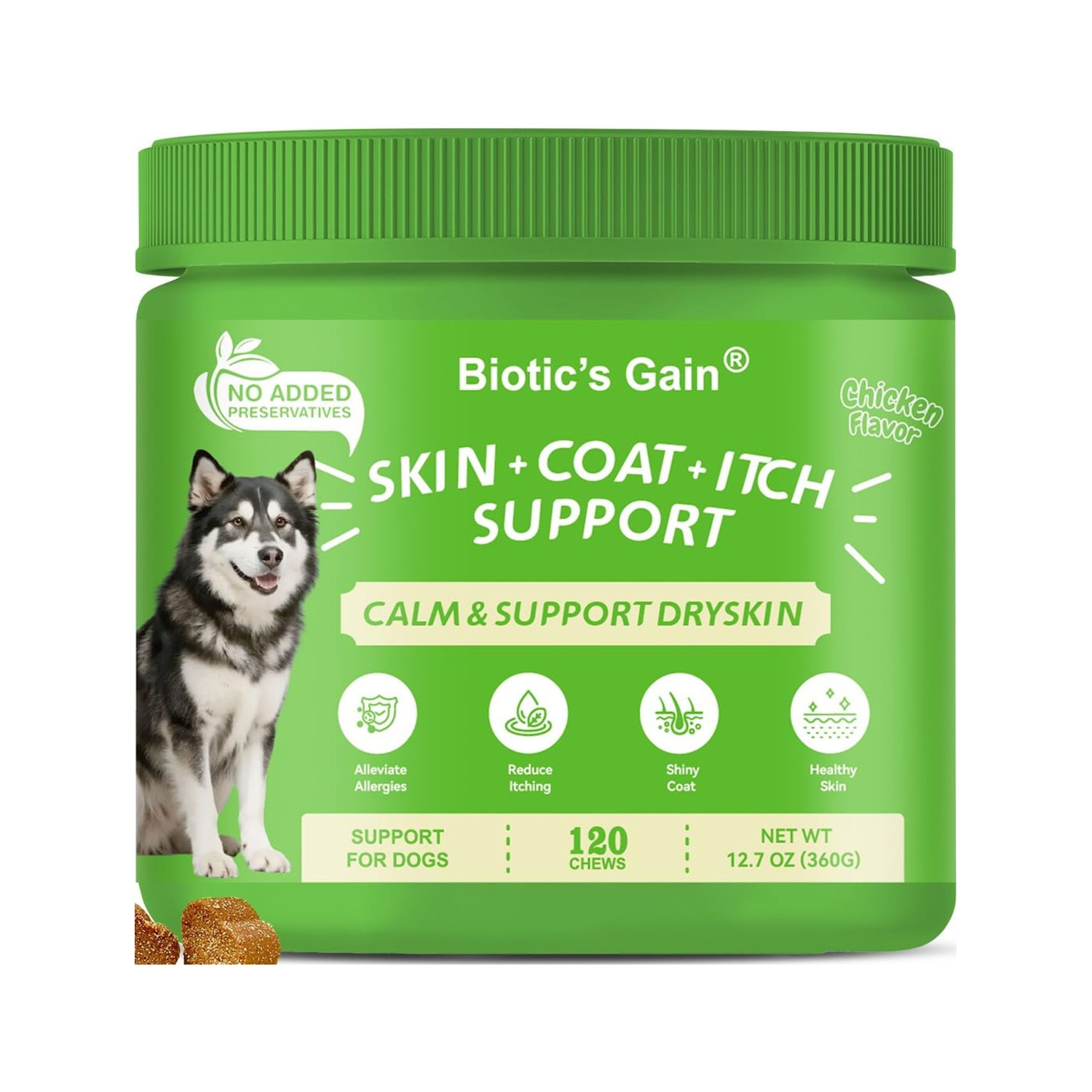
Biotic’s Gain 25-in-1 Dog Multivitamin Chews are a complementary feed, 120 soft chews to a pack, fed to the guide printed on the pack by your dog’s weight and alongside a complete, balanced diet. A complementary feed is food rather than medicine, and cannot treat, prevent or cure anything, including anything described on this page.
It is worth being blunt on a page about ears and eyes: a soft chew is swallowed in seconds and does nothing for either of them. What keeps this part of a dog in good order is a weekly look, a dry ear after a swim, and a phone call made on the day something changes rather than the following week. Speak to your vet before adding anything new to your dog’s routine, particularly if your dog is unwell, pregnant, or receiving medication.
Related reading
Biotic’s Gain chews are a complementary feed for dogs, not a medicine. A complementary feed cannot treat, prevent or cure any condition and should be fed alongside a complete, balanced diet. Follow the feeding guide on the pack, and speak to your vet before adding anything new to your dog’s routine, particularly if your dog is unwell, pregnant, or receiving medication.
Leave a Reply