
A portion is whatever the manufacturer decides it is. Nothing in UK food law sets a portion size, so the serving on the front of a pack is the maker’s own choice, which is why two similar cereals can declare very different amounts per serving. Only the per-100-gram or per-100-millilitre column is compulsory, and because every pack uses the same denominator it is the only figure you can honestly compare one product against another with. For food on a plate, household and hand measures are close enough for everyday purposes: a cupped hand of starchy food, a palm of protein foods, 80 grams for a portion of fruit or vegetables. Weigh things once or twice to calibrate your eye, then stop weighing.
There is no such thing as a legal portion size
Food law in Great Britain has plenty to say about how nutrition information is presented and almost nothing to say about how much of something counts as one helping. If a pack declares its figures per portion, it has to state what that portion is and how many of them the pack contains. The size itself is the manufacturer’s decision. That is why one granola declares a 30-gram serving and another 45 grams, why a chilled pizza that looks like one supper turns out to be two portions on the back of the box, and why a bag of crisps labelled as sharing is being described rather than instructed. The number is a unit of measurement somebody chose, and it is often chosen to make the rest of the panel read better.
Per 100 grams is the only column you can compare
The per-100-gram declaration, or per 100 millilitres for a liquid, is required on a pre-packed food, and it is the one to use when you are standing in an aisle deciding between two jars. Per-portion figures are an optional addition, and comparing two products on them can reverse the answer entirely if one assumes a 50-gram serving and the other 125 grams. The colours on the front of a pack are worked out per portion rather than per 100 grams, which is part of why what the traffic light colours mean is worth understanding before trusting them as a shortcut. Two products can carry the same colours and differ considerably once you put them on the same basis.
Reference intakes, and what the percentages are for
Many packs express a portion as a percentage of a reference intake, usually shortened to RI. Those percentages rest on a notional average adult taking in 2,000 calories, or 8,400 kilojoules, a day, with reference figures including 90 grams of total sugars and 6 grams of salt. The RI exists so that a percentage can be calculated at all; it is a fixed yardstick, not a personal allowance and not a target handed to you by the label. Nobody is the average adult. A nineteen-year-old on their feet all day and a seventy-year-old who is not share exactly the same printed denominator, and the same 15 per cent means something different to each of them.
Hand and household measures that are close enough
Scales are useful for calibration and tedious as a way of life. These rough measures travel with you, scale roughly with the size of the person using them, and are accurate enough for anything outside a clinical setting.
- A cupped hand. One helping of cooked rice, pasta, couscous or potato.
- A palm, fingers not included. One helping of meat, fish, tofu or another protein food.
- Eighty grams. One of the five daily portions of fruit and vegetables: a medium apple, two satsumas, three heaped tablespoons of cooked carrots or peas. Dried fruit counts at 30 grams, and fruit juice counts once a day whatever the glass.
- A thumb. Cheese, butter, peanut butter and other things that get spread or grated without anybody looking.
- A small glass, around 200 millilitres. Milk, or a milk alternative.
- The bowl you already own. Fill it once from a weighed amount and remember where the cereal came up to. That mark is more use day to day than the number ever was.
Where portions quietly drift
Plates and bowls have grown, and a helping that looks modest in a wide shallow bowl looks mean on a small one, which is why eyes calibrated on one set of crockery mislead on another. Serving straight from the pan removes the moment at which anybody decides how much is going on the plate. Eating from the bag or the tub removes it entirely. Restaurant and takeaway helpings follow no standard at all and are not required to tell you anything, so the only honest way to think about them is in whole items rather than grams. None of this is about eating less for its own sake. It is about knowing what you have actually had, because a label figure means nothing if the amount in front of you was never the amount on the pack.
On a supplement, a scoop is not a standard measure
Supplements work the same way. The equivalent of a portion is the recommended daily portion, and it is the manufacturer’s own figure, stated on the back. Two powders can be sold with scoops of different sizes; a serving can be one gummy or two; a tub’s advertised number of servings depends entirely on which of those it assumes. Doses vary widely between brands for reasons worth knowing, which why supplement doses vary so much between brands goes into. Read the portion on the back rather than the headline on the front, and do not exceed the recommended daily portion because a larger scoop happens to be in the tub. The same logic applies to protein powders, where the useful comparison is per 100 grams rather than per scoop — can you get enough protein without a shake works through the everyday arithmetic.
What claim wording on a pack has to follow
Anything a food or supplement pack says about what a nutrient does is fixed by law in Great Britain: only wording authorised on the nutrition and health claims register may be used, the claim belongs to the nutrient rather than to the brand, and the product has to contain enough of that nutrient to qualify. Biotin has seven authorised claims, and these are the two people usually arrive looking for, in their exact permitted form:
- Biotin contributes to the maintenance of normal hair
- Biotin contributes to the maintenance of normal skin
The word “normal” carries both of them and cannot be dropped or traded up: maintenance of normal hair is authorised, thicker or faster-growing hair is not. There is no authorised nails claim in Great Britain, so we make none. We quote no claim wording for any other nutrient mentioned on this page either, because we only quote wording we have checked against the Great Britain register ourselves. What biotin actually does, and what it isn’t allowed to claim sets out the full position, and the rest of our plain-English explainers sit on the thinning hair topic page.
When it is worth asking a pharmacist or GP
- If you have been given dietary advice of your own and are unsure how a general rule of thumb fits alongside it
- If you are weighing and measuring more than feels comfortable, or thinking about food more than you would like to
- If your appetite has changed markedly and you cannot account for it
- Before starting anything new if you are pregnant, breastfeeding, taking prescription medicines or under medical care
Where the Biotin Gummies sit
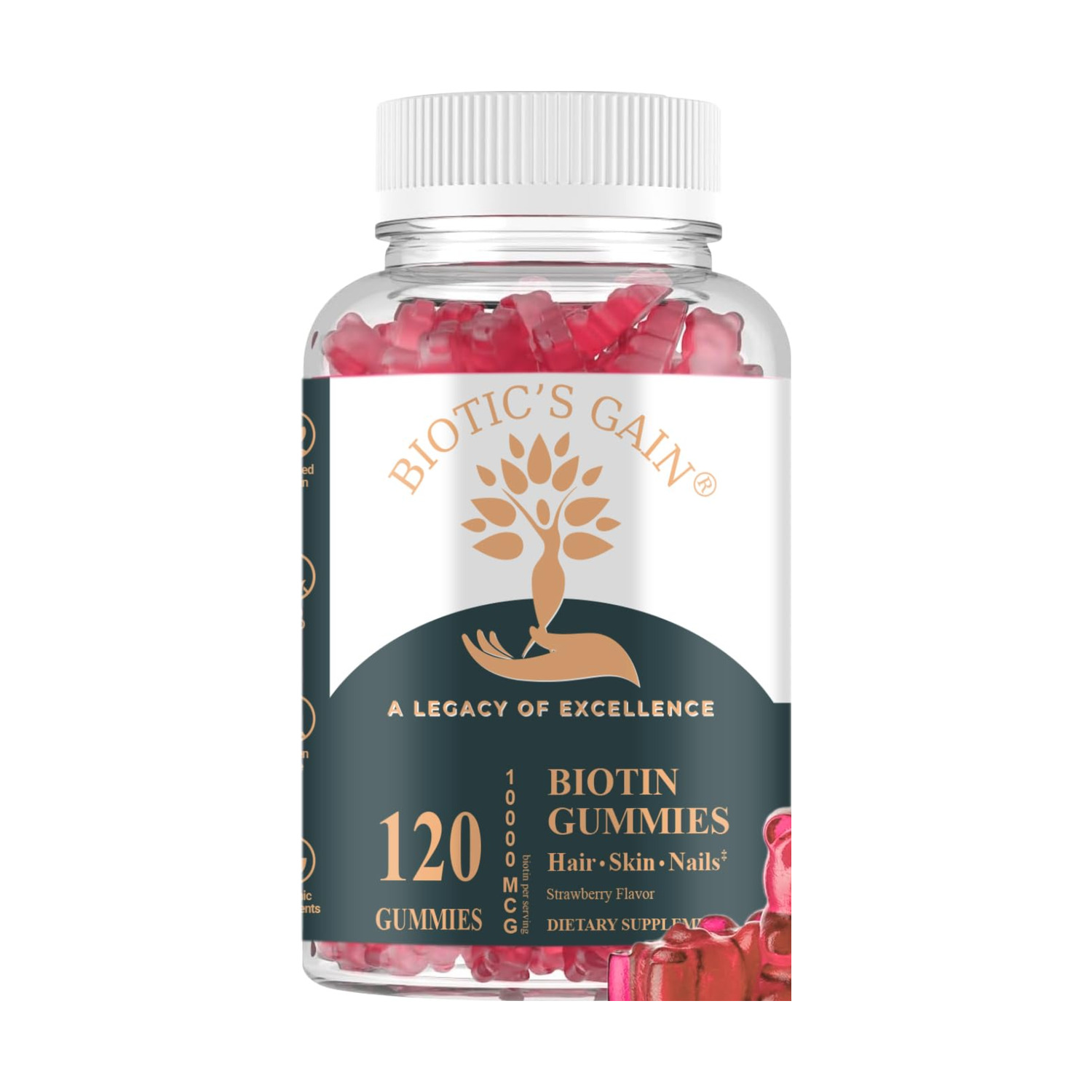
Biotic’s Gain Biotin Gummies are a food supplement rather than a food, supplied as 120 bear-shaped gummies with 10,000 micrograms of biotin in a daily portion. That figure describes what is in the product, which is a description and not a promise, and the portion printed on the jar is the one to follow rather than any number on a product page. The ingredients list on the jar is the authority on what else is in there. A supplement also sits alongside a varied and balanced diet rather than in place of one, which is the whole point of knowing what a portion of ordinary food looks like in the first place.
One practical note worth repeating wherever biotin comes up: high biotin intakes are known to interfere with some laboratory assays, so tell whoever runs the test what you take if you are having blood taken.
Related reading
Biotic’s Gain supplements are food supplements. They are not a substitute for a varied and balanced diet or a healthy lifestyle, and no food supplement can treat, prevent or cure any condition. Do not exceed the recommended daily portion. If you are pregnant, breastfeeding, taking medication or under medical care, speak to a pharmacist or GP first.

Leave a Reply