

Probably safer than you think in some ways and less safe in others, and the way to find out is to walk it slowly at your dog’s height. Four things account for most trouble: a boundary with a gap in it, standing water, the compost heap and bin area, and whatever is stored in the shed. Plants matter too, though fewer than the internet suggests and mostly the bulbs and berries. None of it needs a redesign. It needs one unhurried circuit with fresh eyes, a few things moved to a high shelf, and your vet’s number saved in your phone rather than looked up in a hurry.
Start with the boundary, because escape is the real risk
Of everything in a garden, the fence is the part most likely to cause a genuinely bad day, and it is the part owners check least. Walk the whole line and look for the things a dog looks for: a loose panel at the bottom, a gap where the fence meets a shed or a wall, a hedge thin enough to push through, a gate that only latches when someone remembers to lift it. Dogs find these with time and motivation, and a dog startled by fireworks or chasing a cat is a different animal from the one who potters round the lawn on a Tuesday.
Two details are worth fixing properly rather than temporarily. The first is the gate everyone else uses — meter readers, delivery drivers, the neighbour collecting a parcel — which is how most garden escapes actually happen; a spring closure or a bolt at the top costs very little. The second is the dog who digs along the fence line rather than in the middle of the lawn, since that is a route rather than a hobby. Why dogs dig at all, and what to give them instead, is the subject of why does my dog dig and shred things.
Water: ponds, butts and the puddle nobody notices
A pond is safe enough for a confident adult dog who can find the shallow end, and awkward for a puppy, a small dog or an older dog with stiff back legs, because the problem is never getting in but getting out. A gently sloping edge at one point, or a plank left in as a ramp, solves it. Open water butts, buckets and uncovered pools are worth a lid simply because they are deep and sheer-sided.
The less obvious water is the kind a dog drinks. Standing water in a saucer under a plant pot, a stagnant tray, a puddle on a treated patio or anything that has been sitting on gravel for a fortnight is not the same as water from a bowl. Keep a full, clean bowl outside in summer and most dogs will not bother with the alternatives — how much water should a dog drink covers what normal intake looks like.
The compost heap and the bin corner
An open compost heap is a buffet with a smell signature, and it holds exactly the things you would not hand a dog: mouldering food scraps, onion skins, mouldy bread, fruit stones, cooked bones from a roast, coffee grounds. A closed bin or a lidded tumbler is the whole fix. Garden bins and recycling boxes want the same treatment — a dog who has learned that a bin tips over will keep testing it, which is the pattern why does my dog raid the bin goes into.
The barbecue belongs in this section too. Cooling fat trays, used foil, skewers and dropped bones are collected before the chairs go away, not the next morning. Dogs who hoover things up outdoors generally do it everywhere, and why does my dog eat things off the pavement is the companion piece on the habit itself.
What is in the shed, and what the label says about timing
- Slug pellets, rodent bait and ant powder. Stored high and sealed, used only where a dog cannot reach, and never scattered loose on a bed a dog walks through.
- Weedkiller and lawn feed. The label carries the instruction that matters: how long to keep animals off the treated area, usually until it is fully dry or watered in. Read it before you spray, not after.
- Antifreeze and screenwash. Sweet-tasting, often decanted into unlabelled bottles, and the single most-cited garage hazard by vets. Keep it sealed and clean up spills immediately.
- Cocoa shell mulch. Smells of chocolate because that is what it is made from. There are plenty of other mulches.
- Netting, twine and wire. Fruit netting and loose string wrap round legs and get swallowed; both are worth tidying rather than leaving in a heap.
- Tools, glass and heavy pots. Shears and secateurs put away, cloches and stacked pots checked for the one that will topple.
Plants: a shorter list than you would expect
Most dogs ignore most plants, and most lists online are long enough to be useless. The practical approach is to know the handful that commonly cause problems in British gardens and not worry much about the rest. Bulbs are the main one: daffodil, tulip and spring crocus bulbs are chewed by dogs who dig, and autumn crocus is a different plant that is considerably more of a problem. Then foxglove, yew, laburnum seed pods, lily of the valley, and grape vines, since grapes and raisins are known to affect dogs badly in a way nobody can predict by size.
Autumn brings the seasonal ones. Conkers and acorns are picked up and carried, and both are a choking and obstruction risk before anything else. Windfall apples and plums ferment where they lie, and the stones are their own problem. Anything that grows from a bulb planted in October is a reason to fence that bed for a fortnight. If a plant in your garden worries you and you cannot identify it, photograph it and ask your vet rather than working from a web search — identification is where those searches go wrong.
If you think your dog has eaten something
Ring your vet straight away, including out of hours, and say what you think it was, roughly how much, and when. Take the packet, the label or a piece of the plant with you if you go in, because the name on the box answers questions that guessing cannot. Do not wait to see whether your dog seems unwell, and do not try to make your dog sick — that is a decision for a vet, not a home remedy, and some substances make it the wrong one. General guides on digestive upsets sit on our upset tummy topic page, but a suspected poisoning is a phone call rather than a reading exercise.
When to speak to your vet
- Any suspicion that your dog has eaten a garden chemical, bait, bulb, berry or unknown plant — same day, and sooner rather than later
- Anything swallowed that will not pass: a stone, a conker, netting, string or a piece of a toy
- Repeated vomiting, unusual drooling, wobbliness or sudden lethargy after time outside
- A cut paw, a limp that does not settle within a day, or a wound from a thorn or wire
- Redness or itching after a treated lawn or a brush with a plant, before you try anything on the skin yourself
- Any advice you want about your own garden, your own dog and your own circumstances, which is a conversation we cannot have for you
Where the 25-in-1 Multivitamin sits
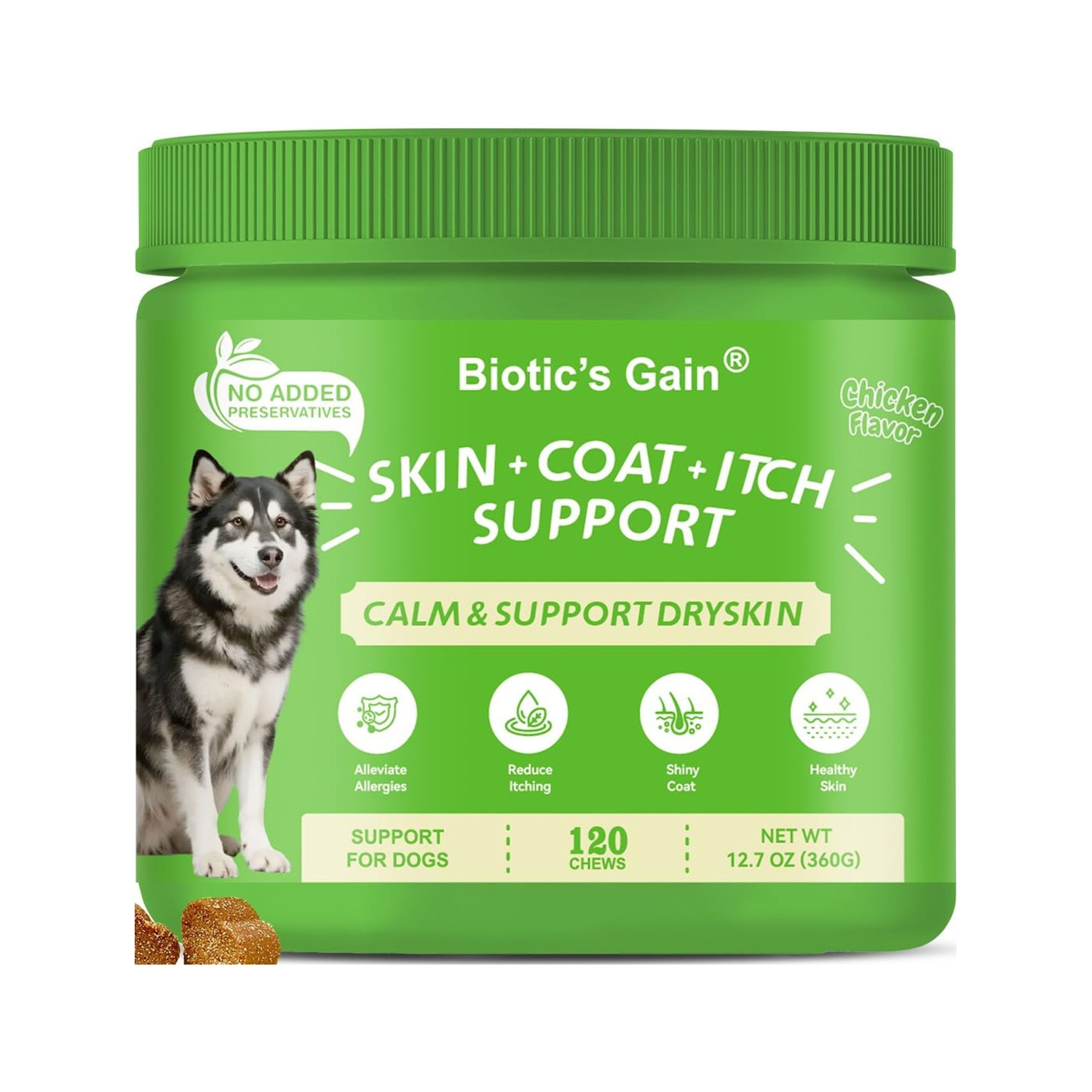
Biotic’s Gain 25-in-1 Dog Multivitamin Chews are a complementary feed, 120 soft chews to a pack, fed to the guide printed on the pack by your dog’s weight and alongside a complete, balanced diet. A complementary feed is food rather than medicine, and cannot treat, prevent or cure anything, including anything described on this page.
It is worth saying plainly on a page about garden hazards: a soft chew is swallowed in seconds and does nothing whatever about a gap in a fence, an open compost bin or a bulb in a flowerbed. What makes a garden safe is the circuit you walk, the lid you fit and the bottle you move to a high shelf. Speak to your vet before adding anything new to your dog’s routine, particularly if your dog is unwell, pregnant, or receiving medication.
Related reading
Biotic’s Gain chews are a complementary feed for dogs, not a medicine. A complementary feed cannot treat, prevent or cure any condition and should be fed alongside a complete, balanced diet. Follow the feeding guide on the pack, and speak to your vet before adding anything new to your dog’s routine, particularly if your dog is unwell, pregnant, or receiving medication.

Leave a Reply