
The trick is to design round the dog you already have rather than fighting the dog you wish you had. Dogs use gardens in predictable ways: a patrol route along the boundary, a shortcut across one corner of the lawn, a favourite lying spot, and a toileting area they pick themselves. Most lawn damage happens exactly where those habits meet grass, so the practical answer is to give the heavy traffic a hard surface, keep the grass for the parts that get walked on less, plant borders that can take a knock, and set aside somewhere digging is allowed. None of it needs a landscaper, and it is far cheaper than reseeding the same bare patch twice a year.
Find the routes before you change anything
Spend a week watching where your dog actually goes. There will be a line along the fence where they check the neighbours, a diagonal between the back door and whatever they bark at, a spot by the gate, and a patch they return to in the sun. Those worn strips are not bad behaviour; they are the garden being used. Fighting them means reseeding forever, because grass cannot recover from being walked on daily by something with four sets of claws.
Once you know the lines, the fix is cheap. A strip of paving slabs, a run of bark or a gravel path laid along the route takes the traffic and the grass either side survives. A path along the inside of the fence looks deliberate and solves the patrol worn into the lawn edge. One tip from experience: lay the path where the dog already walks, not where you would prefer, or you will end up with both a path and a worn strip.
Why the grass wears and burns where it does
Two different things are usually blamed on each other. Wear is mechanical: compacted soil, torn crowns, and grass that cannot regrow because it is trodden before it gets going. It is worst in winter, when growth stops and the ground is soft, and it concentrates on turns and stops rather than straight runs.
The yellow or brown rings with a green edge are something else: dog urine is high in nitrogen and salts, and grass takes a concentrated dose of it badly, which is why the ring is scorched in the middle and lush round the rim where the dose was diluted. Watering the spot soon after helps, as does keeping a watering can by the door in summer. Male and female dogs both do it; the rings are more obvious from a squat than from a leg lift against a post. What does not fix it is anything fed to the dog — we make no claim that any supplement changes what urine does to a lawn, and would be wary of anyone who does. If you want grass that survives it, a hard-wearing rye-based mixture over an area you can rinse is a more honest answer than a product.
The bit by the back door
Whatever the rest of the garden looks like, the two metres outside the door takes the worst of it and turns to mud from November onwards. It is the single most worthwhile thing to harden: slabs, a bound gravel pad, or even a run of rubber matting over the worst of it. Add a tap or an outside water point if you can, because rinsing paws outside is far better than carrying a muddy dog through the kitchen.
Keep a towel on a hook by that door rather than in the airing cupboard, and dry between the toes rather than just the top of the paw, since that is where grit and seeds collect. Dogs who are forever licking their feet after a muddy walk are worth a closer look rather than more washing; our itchy skin topic page is the general guide, and a persistent one is a vet conversation.
Borders that survive a dog
- Plant densely. A full border is walked round; a sparse one with bare soil between plants is walked through. Density does more than any barrier.
- Raise the edge. Even a low brick or timber edge, 15 or 20 centimetres, reads as a boundary to most dogs and stops the casual shortcut.
- Put the fragile things up. Raised beds, troughs and pots on a hard surface keep seedlings, salad and anything precious out of the traffic entirely.
- Choose tough shrubs for the front row. Hebe, lavender, dogwood, euonymus and ornamental grasses take a knock and spring back; delphiniums and dahlias do not.
- Mind the mulch. Bark chips get chewed and carried, and large pieces are a choking and obstruction risk with dogs who pick things up. Cocoa shell mulch is made from cocoa and belongs nowhere near a dog. Sharp angular gravel is hard on pads; rounded pea shingle is kinder.
- Keep netting and twine tidy. Fruit netting and loose string wrap round legs and get swallowed, which is a worse outcome than a few eaten raspberries.
Which plants are worth knowing about, and why the online lists are longer than they need to be, is covered in is your garden safe for a dog, along with the boundary, water and shed checks that matter more than planting does.
Give digging somewhere to go
A dog who digs will keep digging, and the realistic aim is to move it rather than stop it. A dedicated digging area — a sandpit, a raised bed of loose soil, a corner you have written off — with a few things buried in it is a genuine solution, particularly for terriers and for young dogs. Take them to it, bury something worth finding, and make a fuss when they use it. Digging in the borders gets interrupted and redirected, not punished after the event, since a dog cannot connect the two.
Digging along the fence line is a different matter, because that is an escape route rather than a hobby and wants a physical fix. The reasons behind the habit, and what to offer instead, are in why does my dog dig and shred things.
Lawn treatments, seed and timing
Anything you put on the lawn carries an instruction about animals on the label, usually to keep them off until the product has dried or been watered in. That instruction is the one that matters, and reading it before you spread rather than afterwards saves a difficult phone call. The same applies to feed, moss killer and weed-and-feed products, and to slug pellets anywhere a dog walks.
Repairs want timing as much as seed. Autumn and spring are when grass establishes, and new seed needs two or three weeks genuinely free of paws, which usually means fencing the patch off with canes and netting rather than hoping. If a bare area is permanently on a route, reseeding it is throwing money at a path — that is the spot to pave.
When to speak to your vet
- Any suspicion your dog has eaten a lawn treatment, slug pellets, mulch, a bulb or an unknown plant — the same day, and sooner rather than later
- A cut pad, a thorn, a limp that has not settled within a day, or a swelling between the toes
- Persistent licking or chewing of the feet after time outside, or redness that follows a treated lawn
- Anything swallowed that will not pass: a stone, a conker, a piece of bark or netting
- Sudden drooling, repeated vomiting or wobbliness after being in the garden
- Any advice about your own garden, your own dog and your own circumstances, which is a conversation we cannot have for you
Where the Skin & Coat chews sit
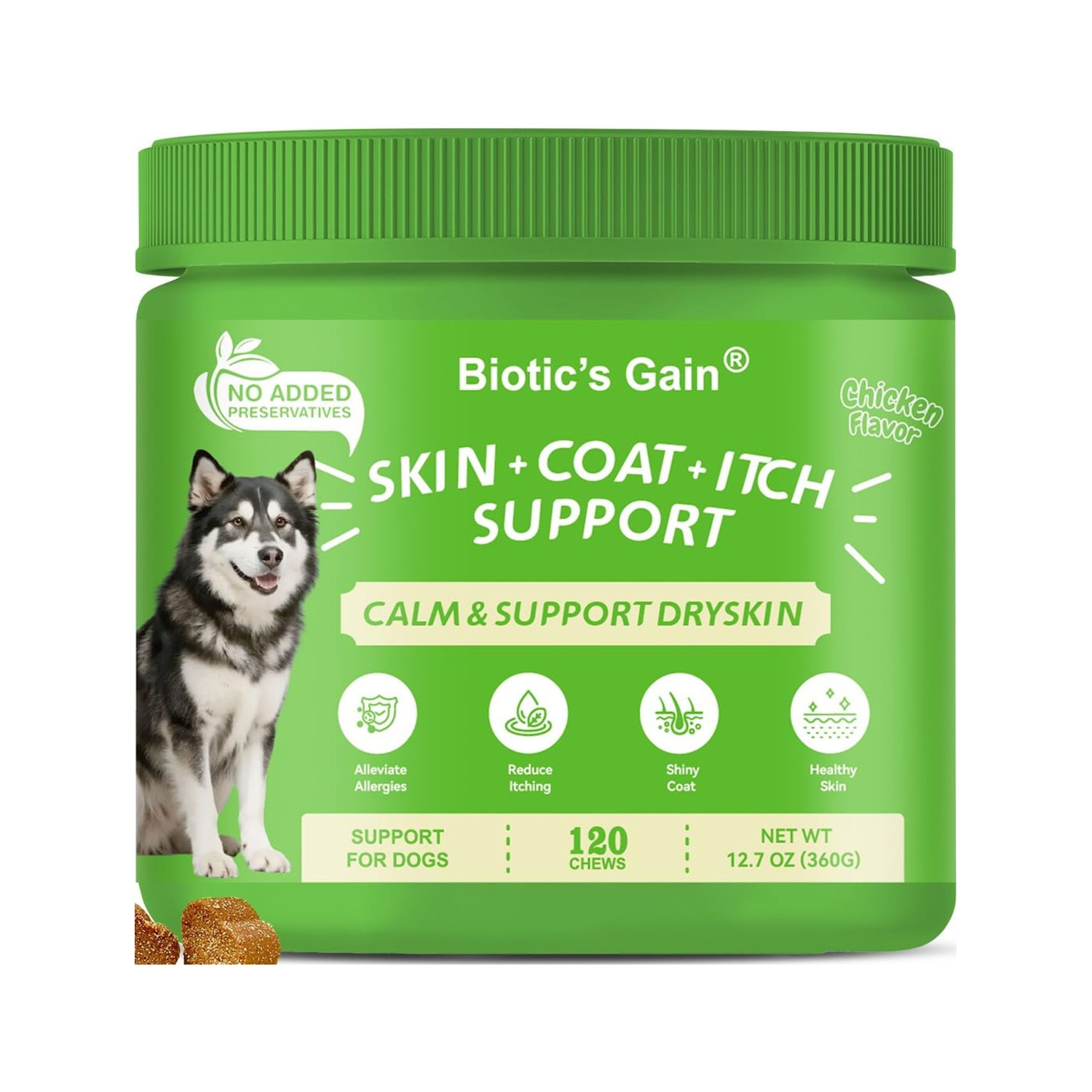
Biotic’s Gain Omega 3 for Dogs Skin & Coat Soft Chews are a complementary feed containing omega-3 fatty acids with biotin and zinc, fed to the guide printed on the pack by your dog’s weight and alongside a complete, balanced diet. A complementary feed is food rather than medicine, and cannot treat, prevent or cure anything, including anything described on this page.
Worth saying plainly on a page about lawns: a soft chew does nothing about mud, a worn track or a dug-up border, and nothing we feed a dog changes how grass responds to urine. What changes a garden is the path you lay where the dog already walks, the digging pit you set aside and the label you read before spreading anything. Speak to your vet before adding anything new to your dog’s routine, particularly if your dog is unwell, pregnant, or receiving medication.
Related reading
Biotic’s Gain chews are a complementary feed for dogs, not a medicine. A complementary feed cannot treat, prevent or cure any condition and should be fed alongside a complete, balanced diet. Follow the feeding guide on the pack, and speak to your vet before adding anything new to your dog’s routine, particularly if your dog is unwell, pregnant, or receiving medication.

Leave a Reply