
Often it does, but slowly, and less dramatically than supplement marketing suggests. A dog’s coat is built almost entirely from protein, so a complete, properly balanced food is already doing most of the work. What diet changes is the margin — a dull or dry coat sometimes looks better once a dog is on a food that suits them, and the fats in that food affect how the skin holds moisture. The catch is timing. Hair grows in cycles measured in months, so nothing you change today shows up in the coat for six to eight weeks at the earliest. And a sudden coat change is more often a parasite or health question than a food one, which makes it a conversation for your vet first.
What a coat is actually made of
Hair is keratin, and keratin is protein. A dog growing and replacing coat all year is putting a substantial share of the protein it eats straight into hair, which is why coat condition is one of the first visible things to change when a dog’s overall nutrition or health shifts. Skin is the other half of the picture: it is the largest organ a dog has, it renews constantly, and the oils it produces are what give a healthy coat its shine.
Most dogs have two kinds of hair: longer, coarser guard hairs that shed water and take the wear, and a softer undercoat underneath that does the insulating. What “a good coat” looks like therefore depends enormously on the breed — a wiry terrier coat and a spaniel’s feathering are not meant to look the same, so comparing your dog to someone else’s is a poor test.
Where food comes into it
Two parts of the diet show up in the coat more than the rest. The first is protein — both how much and how digestible it is. A food built on ingredients a dog absorbs well gives more usable material for hair growth than one padded out with fillers, which is part of why cheap and expensive foods can list similar protein percentages and produce visibly different results.
The second is fat. Fatty acids are part of the skin’s barrier, and the barrier is what keeps moisture in and irritants out. Dogs on food that has been stored badly and gone stale often look duller than dogs on the same brand from a fresh bag. Fat is also how the fat-soluble vitamins travel, so cutting it hard has knock-on effects beyond the calories.
Beyond those two, the honest answer is that outright dietary deficiencies are rare in dogs eating a complete food. Complete diets sold in the UK are formulated to supply everything a dog needs, and the manufacturers test against established nutritional standards. If your dog eats a complete food and nothing else, the coat problem in front of you is more likely to be about parasites, allergies, grooming or health than about a missing nutrient.
Complete food and complementary feed are not the same thing
This distinction is written into feed law and it is the single most useful thing an owner can understand about supplements. A complete food is designed to be the whole diet: fed at the right amount, it supplies everything. A complementary feed is not, and is never meant to be — it sits alongside a complete diet and is fed in addition to it, not instead of part of it.
Every dog supplement on the market, including ours, is a complementary feed. That is not a limitation being hidden; it is what the category is. It also means the sensible order of operations is diet first, supplement second. If a dog’s food is not suiting them, changing the food is the bigger lever, and no chew is a substitute for getting that right. We go through the label mechanics — composition order, analytical constituents, additives, feeding guides — in our guide to reading a dog supplement label.
Why any change takes so long to show
Hair does not grow continuously. Each follicle runs through a growth phase, a transition, a resting phase and then shedding, and the follicles on a dog are not synchronised with each other. The practical consequence is that the coat you are looking at today was largely grown weeks or months ago. Change the food tonight and the hair already on the dog is unaffected — only new growth carries the difference.
Six to eight weeks is a reasonable minimum before judging anything, and a full turnover of the visible coat can take a season. That cuts both ways: it stops you writing something off after a fortnight, and it should make you suspicious of anything promising a transformation in days. Take a photo at the start, too — owners see their dog every day and are the worst judges of gradual change.
What the Skin & Coat chews are
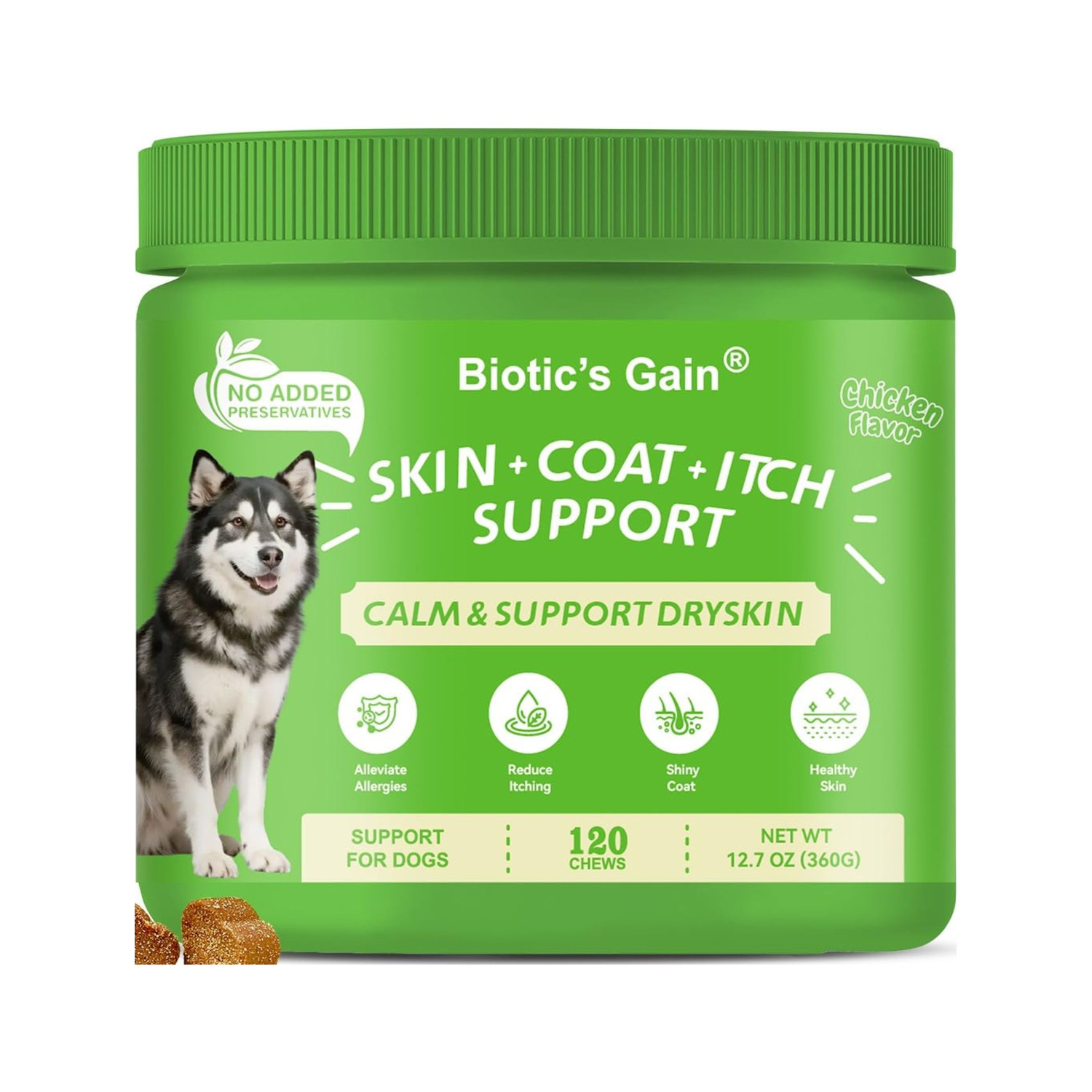
Biotic’s Gain Omega 3 for Dogs Skin & Coat Soft Chews are a complementary feed containing omega-3 fatty acids along with biotin and zinc, in a soft chew format that most dogs take as a treat. They are fed alongside a complete and balanced diet, following the feeding guide on the pack, which is sized to the dog’s weight — the guide exists for a reason and more is not better.
We describe them factually and leave it there. A complementary feed cannot claim to treat, prevent or cure anything, and we are not going to imply otherwise by dressing a description up as a result. If you are already feeding a complete diet, grooming regularly and your dog’s skin is healthy, a supplement is an optional extra rather than a missing piece. If something is actually wrong, it is a veterinary question, not a shopping one.
The things that are not diet at all
Plenty of what owners blame on food turns out to be something else entirely:
- Parasites. Fleas and mites are still the most common reason a coat goes to pieces, and a dog can react badly to very few fleas.
- Grooming, or the lack of it. Brushing lifts dead hair and distributes skin oils; a matted or neglected coat looks poor no matter what the dog eats.
- Over-washing. Bathing too often strips the oils faster than the skin replaces them, which is covered in how often you should actually bathe a dog.
- Season and daylight. The big spring and autumn moults are driven by changing light, not by anything on the ingredients list — see why dogs shed so much.
- Indoor air. Central heating dries out skin over a winter in much the same way it dries out ours.
- Age and life stage. Puppy coats change, older dogs’ coats change again, and neither is a problem to be fixed.
When to book the vet rather than change the food
Make an appointment rather than experimenting if you see bald patches or hair coming out in clumps from one area, red or broken skin, scabs, an unusual smell, a dog scratching or chewing enough to interrupt sleep, or a coat that changes suddenly rather than gradually. The same applies if a coat change arrives alongside anything else — weight change, drinking more, low energy, or a shift in appetite.
Itching in particular has a long list of causes and food is well down it, which is why we wrote why a dog might be scratching when there are no fleas. Your vet can rule things in and out in one visit that would take months of guessing at foods. If you are working through skin and coat generally, our itchy skin guide is the place to start, and speak to your vet before adding any supplement to a dog on medication or under treatment.
Related reading
Biotic’s Gain Skin & Coat chews are a complementary feed for dogs, fed alongside a complete and balanced diet rather than in place of one. Nothing here is veterinary advice, and no supplement can treat, prevent or cure a health problem. If your dog’s skin or coat changes, or if they are unwell, on medication or under treatment, speak to your vet.

Leave a Reply