
Nearly every dog sheds, and for most of them the volume is normal rather than a problem. Hair grows in cycles, and every hair that reaches the end of its cycle is eventually pushed out and replaced — a dog simply has an enormous number of them going through that process at once. Double-coated breeds moult heavily twice a year as the soft undercoat is released, while many single-coated dogs drop hair at a steady low level all year round. Central heating and artificial light blur the seasonal pattern, so indoor dogs often shed a little constantly. What is worth a closer look is hair loss that comes with bald patches, broken hair, redness or persistent scratching — that is a conversation with your vet rather than a grooming question.
How a dog’s coat actually works
A dog’s hair does not grow continuously. Each follicle runs through a cycle: a growing phase, a short transitional phase, a resting phase, and then the point at which the old hair is released and a new one starts pushing up behind it. The hair you find on the sofa is mostly hair that finished its cycle days or weeks ago and had been sitting loose in the coat waiting for a scratch, a stroke or a shake to free it.
Most dogs carry two kinds of hair. Guard hairs are the longer, coarser outer hairs that give the coat its colour and shed water. Underneath sits the undercoat, which is softer, shorter and far denser, and which exists to trap air for insulation. The two behave quite differently: guard hairs turn over fairly steadily, while undercoat tends to be released in large quantities at once. That single fact explains most of what owners notice about shedding.
Why double coats moult in bursts
Huskies, German Shepherds, Labradors, Collies, Akitas, Samoyeds, Corgis and plenty of crossbreeds carry a proper double coat, and they go through what owners usually call “blowing coat”. In spring the dense winter undercoat is released as daylight lengthens; in autumn a lighter summer undercoat comes out to make room for the winter one. For two or three weeks in each of those windows the amount of hair coming off a dog can look genuinely alarming, and it can come away in soft clumps rather than individual hairs.
It is driven by light rather than temperature, which catches people out. A mild winter does not cancel the spring moult, because the trigger is the changing day length picked up through the eyes. This is also why the pattern can be unpredictable in a dog who spends most of the day indoors under artificial lighting.
Why indoor dogs seem to shed all year
A dog living in a heated house with the lights on until eleven at night is getting a much flatter signal about the season than a dog living mainly outdoors. The result is that the two clean moults smear out into a low-level, year-round shed. Nothing has gone wrong; the same amount of hair is coming off, just spread across twelve months instead of concentrated into four weeks. For most owners this is actually the easier version to live with, even though it feels relentless.
Breed and coat type: what to expect
Coat type sets the baseline, and no amount of grooming or feeding will move a dog off it. Double-coated breeds shed the most by volume. Short, single-coated dogs such as Beagles, Boxers and Staffies shed steadily and, because the hairs are short and stiff, work their way into fabric more stubbornly than long hair does. Wire-coated terriers shed comparatively little but need hand-stripping or clipping to keep the coat in order.
Poodles, Bichons and many of the doodle crosses have hair that grows more or less continuously rather than cycling out quickly, so very little lands on the floor — but the shed hair stays trapped in the coat and mats if it is not brushed out, which is a different job rather than a lesser one. “Low-shedding” and “low-maintenance” are not the same thing, and the grooming bills tend to make that point eventually.
What grooming actually changes
Brushing does not reduce how much hair a dog loses. What it does is decide where that hair ends up — in the brush rather than on the carpet — and it gets the loose undercoat out before it has a chance to felt down against the skin. During a heavy moult, ten minutes daily with an undercoat rake or a slicker brush will make more difference to your house than anything else you can do.
Bathing loosens shed hair, so a bath followed by a thorough dry and brush-out during a moult clears a lot at once. Bathing too often is worth avoiding, though, since it strips the natural oils that keep the coat sitting properly. A dog shaved down in summer is another common mistake with double coats: the undercoat insulates against heat as well as cold, and shaving it out changes how the coat regrows, sometimes patchily.
Diet, and where supplements sit
Hair is largely protein, and growing a whole new coat twice a year is a real nutritional job, so a complete and balanced dog food doing its work is the foundation of coat condition. A complete food is formulated to supply everything a dog needs, including the fatty acids, vitamins and minerals involved in skin and hair. Dogs cannot make certain omega-3 fatty acids themselves and take them in through the diet.
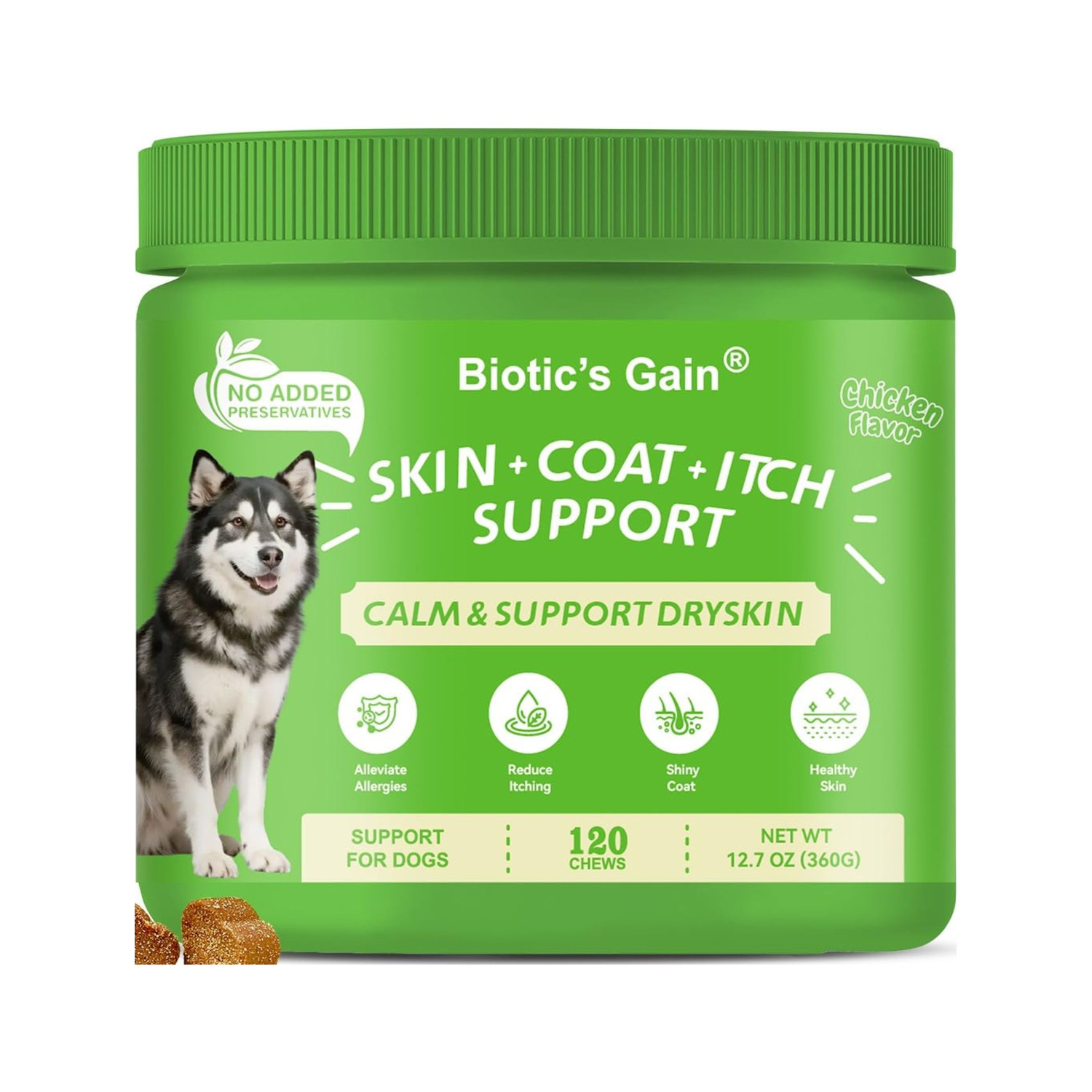
Biotic’s Gain Omega 3 for Dogs Skin & Coat Soft Chews are a complementary feed containing omega-3 fatty acids together with biotin and zinc. Complementary means exactly what it sounds like: they are fed alongside a complete diet, not instead of one, following the feeding guide on the pack for your dog’s weight. They are food, not medicine, and they are not a treatment for anything. If you want to understand what the wording on any dog supplement pack is telling you, our guide to reading a dog supplement label walks through it section by section.
When shedding is worth a vet’s opinion
Normal shedding is even. Hair comes away across the whole dog, the skin underneath looks ordinary, and the dog is not bothered by it. Book an appointment if you see bald or thinning patches, hair that breaks off rather than pulling free, redness, scabs, an unusual smell, sudden flaking, constant scratching or chewing, or a coat that changes texture noticeably over a few weeks. A sudden very heavy shed outside the usual windows is also worth mentioning, since stress, illness, whelping or a recent general anaesthetic can all push a lot of follicles into the resting phase at the same time.
Your vet is the person to work out what is behind any of that. It is not something to guess at from a website, and it is not something a supplement answers. If the scratching is the part that worries you most, why a dog itches when there are no fleas covers the usual suspects, and our itchy skin guide is a good place to start.
Related reading
Biotic’s Gain dog chews are a complementary feed, not a medicine. They are not intended to diagnose, treat, cure or prevent any condition, and they are fed alongside a complete and balanced diet following the feeding guide on the pack. If your dog is unwell, losing hair in patches, on medication, pregnant or already under veterinary care, speak to your vet before adding any supplement.


Leave a Reply