
Both work by getting inside the hair, and the only way in is through the cuticle. Permanent colour and bleach use an alkaline agent to swell the fibre and lift those outer scales, then peroxide to alter or strip the pigment in the cortex underneath. Bleach goes furthest, because it has to dissolve pigment rather than replace it, and it keeps working for as long as it sits on the hair. What comes out the other side is more porous, weaker when wet and rougher to the touch, and none of that reverses. New growth arrives untouched, but the processed length stays processed, so spacing the chemistry out matters far more than any bottle bought afterwards.
How colour gets into a hair at all
A hair is built in layers. The cuticle is the outside: overlapping scales that lie flat when hair is in good condition and give it its shine and its slip. Underneath sits the cortex, the bulk of the fibre, where the keratin that gives hair its strength is packed alongside the melanin that gives it its colour. Anything that changes colour permanently has to reach the cortex, and the cuticle is in the way.
So the first thing a permanent colour or a bleach does is raise the pH. An alkaline agent, usually ammonia or one of the gentler-smelling substitutes, makes the fibre swell and the cuticle scales lift away from each other far enough for small molecules to pass through. Then hydrogen peroxide does the chemical work in the cortex. In a permanent colour it both lightens the existing pigment and triggers the new dye molecules to form and lock in place; in bleach it does nothing but take pigment apart.
That lifting is the cost. Cuticle scales that have been swollen open do not settle back exactly as they were, which is why coloured hair feels rougher, tangles more and loses water faster than it used to. It is the same surface that heat styling wears down, which is why the two together are harder on hair than either on its own.
Bleach is the harshest thing most people do to hair
Colour adds something. Bleach only removes, and it cannot be selective about it. Oxidation breaks melanin into colourless fragments small enough to wash out, and in the process it also oxidises some of the protein and the fatty layer that holds the cuticle together. Hair that has been lifted several shades has lost structural material, not just pigment, and that is why it behaves differently afterwards: stretchier when wet, more fragile at the ends, slower to dry properly and quicker to feel like straw.
How far it goes depends on how much lift is being asked for. Two shades on dark blonde is a modest job. Dark brown to platinum is several levels of pigment removal, often in more than one session, and it is the point at which over-processed hair can simply give way in the hands, sometimes during the rinse. That is not a rare horror story; it is the predictable end of asking for too much lift at once, and a good colourist will refuse rather than risk it.
Permanent, demi and semi: how far in each one goes
- Permanent. Alkaline agent plus peroxide. Lifts the natural pigment and deposits new colour inside the cortex. Grows out as a line of regrowth rather than fading away, and is the only route to going lighter.
- Demi-permanent. Low peroxide, no ammonia or very little. Deposits tone without lifting, so it can darken or adjust a shade but not lighten one. Milder on the fibre and fades over a couple of months.
- Semi-permanent. Larger pigment molecules that mostly sit on and just under the cuticle. No peroxide, no lift, washes out over a handful of shampoos. The gentlest option by a wide margin.
- Bleach, then tone. Any blonde that is lighter than the natural base is this: pigment removed first, then a toner laid over the raw yellow underneath. The toner is mild; the step before it is not.
- Box colour versus salon. The chemistry is the same family. The difference is that a box carries one developer strength for every head, while a colourist chooses strength and timing for the hair in front of them and can leave the lengths alone.
Perms, relaxers and smoothing treatments
Colour works on pigment. The texture services work on the bonds that hold keratin in its shape, and they are a bigger intervention than most people realise. A perm breaks the strong sulphur bonds in the cortex with a reducing agent, holds the hair in a new shape and then reforms those bonds with a neutraliser. A relaxer does the same job in the opposite direction, usually at a very high pH, which is why scalp protection and timing are not optional with one.
Smoothing or keratin treatments are a different mechanism again: a coating is sealed onto the fibre with a hot iron, so the result depends on heat as well as chemistry. Whatever the method, the common thread is that permanently rearranging a fibre means deliberately weakening it first, and hair that has already been bleached has less structure to spare. Stacking a texture service on top of lightened hair is the combination most likely to end badly.
Where the real damage usually comes from
Rarely one appointment. Almost always accumulation, and three patterns account for most of it.
The first is overlap. Regrowth needs colour; the lengths already have it. When product is dragged through the whole head every six weeks, the mid-lengths get processed again and again while the roots get it once. The second is ends. The tips of long hair may be three or four years old and have been through every process, every summer and every brush stroke since. They have the least left to give, which is why damage shows there first. The third is combining. Colour, heat and tension each cost something, and a bleached fibre put under a hot iron and then tied back tightly is paying three times. Why hair breaks instead of growing longer sets out how that ends.
Living with coloured hair
- Stretch the gap between services. Eight or ten weeks instead of five halves the number of processes a head of hair sees in a year.
- Keep the lengths out of it. Root-only application with a gloss or toner refresh through the ends does most of what a full head does, at a fraction of the cost to the fibre.
- Go in stages. Several sessions to reach a lighter shade is slower and more expensive, and it is the difference between hair that gets there and hair that does not.
- Drop the heat. Processed hair needs a lower setting than it did before, not the same one.
- Handle wet hair gently. It is weakest then and more so once porous. A wide-tooth comb from the ends upwards, and no rough towelling.
- Bond-building products, honestly described. They work on bonds broken during the service and reduce the damage done at the time. They are a mitigation, not a repair of hair already wrecked.
- Patch test every time. Dye allergies can appear after years of using the same product, and a reaction to hair dye can be serious. Test 48 hours before, including on a box you have used before.
- Mind the chlorine and the sun. Both oxidise hair that has already been oxidised. Wet the hair before a pool and it absorbs less of what is in the water.
- Accept the trim. Split ends travel. Cutting them off is the only thing that actually removes them.
What a supplement can and cannot say here
This is where the marketing tends to drift, so it is worth being exact. In Great Britain only wording authorised on the nutrition and health claims register may be used, and for biotin there are seven authorised claims. Two are the ones people arrive at a page like this for, and these are the exact permitted wordings:
- Biotin contributes to the maintenance of normal hair
- Biotin contributes to the maintenance of normal skin
The word “normal” is doing real work in both sentences. It cannot be dropped and it cannot be traded up: maintenance of normal hair is authorised, while stronger, thicker, faster-growing or bleach-proof hair is not. There is no authorised nails claim in Great Britain, so we make none, however often you see one elsewhere. And nothing on the register speaks to a fibre that has already been chemically processed. No nutrient is authorised to repair, reseal or reverse that, because the hair on your head is dead tissue and cannot be mended from the inside. We only quote claim wording we have checked against the Great Britain register ourselves. What biotin actually does, and what it isn’t allowed to claim sets out the full position, and the rest of our plain-English explainers sit on the thinning hair topic page.
The division is clean enough. Diet belongs to the hair still being made below the skin, where the register wording goes no further than maintenance of normal hair. Everything a colourist does happens to hair that left the scalp months or years ago, and how hair actually grows explains why any change takes months rather than weeks to judge either way.
When it is worth asking a pharmacist or GP
- Any swelling, rash, blistering or burning after a colour service or a home kit, and anything affecting the face or breathing urgently
- A sore, flaking or persistently itchy scalp that does not settle within a few days
- Hair coming away at the root in noticeably larger amounts, rather than snapping mid-length
- A widening parting, patchy loss, or bald areas with no obvious cause
- A change that began a few months after an illness, an operation, a pregnancy or a new prescription
- Any hair change you are worried about, and take a list of what you take to the appointment
Where the Biotin Gummies sit
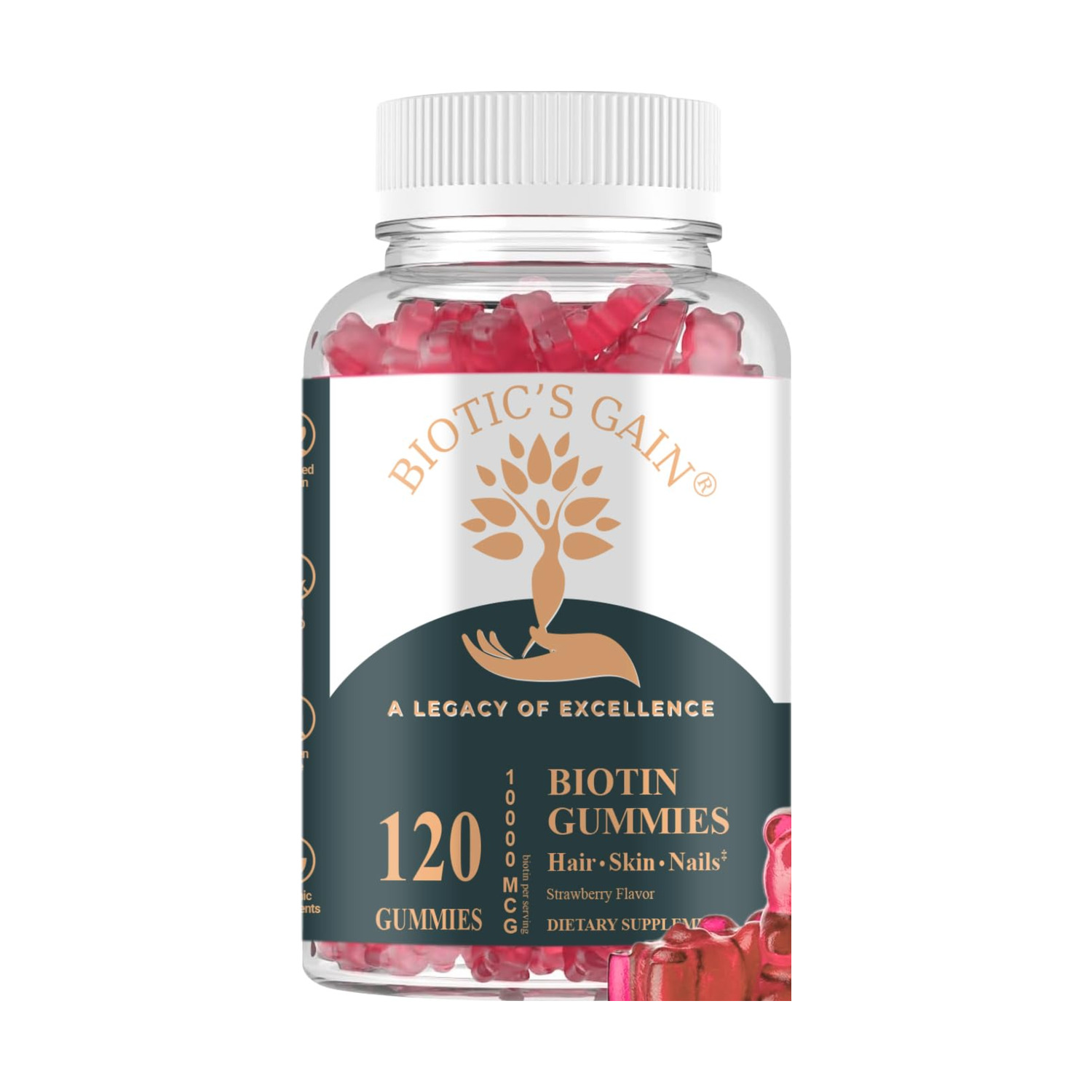
Biotic’s Gain Biotin Gummies are a food supplement, with the amount of biotin in the daily portion stated on the pack. That figure describes what is in the product, in the same way that 25g of protein per serving describes a tub of whey isolate. It is a description rather than a promise, and on a page about bleach it would be a particularly poor one: what happens in a salon chair is chemistry done to hair that is already made, and no tub reaches it.
If the base, the sweetener or an allergen matters to you, the ingredients list on the jar is the authority, and that holds for every brand on the shelf. A pharmacist is the easiest person to ask if you take prescription medicines or are pregnant or breastfeeding. One practical point worth repeating: high biotin intakes are known to interfere with some laboratory assays, so if you are having blood taken, tell whoever runs the test what you take.
Related reading
Biotic’s Gain supplements are food supplements. They are not a substitute for a varied and balanced diet or a healthy lifestyle, and no food supplement can treat, prevent or cure any condition. Do not exceed the recommended daily portion. If you are pregnant, breastfeeding, taking medication or under medical care, speak to a pharmacist or GP first.

Leave a Reply