
There is no single figure, and the hour a day everyone quotes suits almost no dog exactly. A healthy adult dog of a working breed may want two hours of varied activity; a small companion breed, an older dog or a flat-faced breed may be well served by half of that. Age sets the ceiling as much as breed does: puppies need little and often while their joints are still growing, and older dogs usually do better on shorter, more frequent outings than on one long march. Judge it by the dog in front of you — settled at home, keen on the lead, sound the next morning — rather than by a number.
Why “an hour a day” is the wrong unit
An hour of lead walking along a pavement and an hour off the lead in a field are not the same hour. The first is mild activity with little for the brain to do; the second can leave a dog properly tired. Two owners can both say “we do an hour a day” and have completely different dogs at the end of it.
Three things matter together: how long, how hard, and how much thinking is involved. A short walk with plenty of sniffing and a few minutes of training in it often does more for a dog’s evening than a long, brisk march. That is not a reason to cut walks short — it is a reason to stop treating the clock as the measure.
Rough guides by age
- Puppies. Little and often. A widely used rule of thumb is five minutes of formal walking per month of age, once or twice a day — twenty minutes at four months. It is a guideline rather than a law, and it exists because growth plates are still open. Free play in the garden, at the puppy’s own pace, is a different thing from a long enforced walk.
- Adolescents, roughly six to eighteen months. The stage where owners usually over-walk, because the dog seems tireless and is not. That energy is often restlessness rather than unmet exercise need, and more distance can make it worse.
- Adults. Anywhere from thirty minutes to two hours or more of combined activity, depending on the dog. Most pet dogs land near an hour, split across the day.
- Older dogs. Usually the same total or a little less, broken into shorter, more frequent outings. Three twenty-minute walks suit a stiff twelve-year-old far better than one long hike.
Breed and build change the answer
Dogs were shaped for different jobs and it shows. A collie, a spaniel or a working-line labrador was bred to be busy for hours and will tell you about it if they are not. A greyhound is a sprinter with an off switch, often content with two moderate walks and a short burst of speed. Terriers want intensity rather than distance.
Two groups need particular care. Flat-faced breeds — pugs, French bulldogs, boxers — move air less efficiently, so heat and exertion stack up quickly, and a walk that suits a labrador can be unsafe for them on a warm day. Giant breeds grow for much longer than small ones, so the careful-with-joints period stretches well past a year. Build matters more than the breed average, too: a leggy, lean dog usually handles more than a heavier-set littermate.
Activity is not only walking
A lot of what tires a dog out is mental rather than physical. Letting a dog follow a scent trail at their own pace is hard work for them, as what dogs can actually smell explains. Five or ten minutes of training, scatter-feeding a meal in the grass, or a food puzzle instead of a bowl all count towards the day in a way that pavement miles do not.
That matters most when walking is restricted — bad weather, a recovering dog, a lame paw, dark evenings. Swapping physical load for mental load is often the difference between a settled evening and a dog who keeps fetching a toy.
Too little, and too much
Under-exercised dogs look busy indoors: pacing, pestering, chewing, barking at nothing much, unable to settle in the evening. The same signs can come from boredom despite plenty of walking, covered in whether a dog is anxious or just bored.
Over-exercise is less talked about and does happen, especially with young dogs and enthusiastic owners. The signs come afterwards: lagging behind on the way home, stiffness or a slight limp the next morning, reluctance to set off at all. Repetitive high-impact activity — long sessions of ball-throwing, hard turns on wet grass, running alongside a bike on tarmac — is the usual cause, and the early signs of stiffening joints are worth knowing before you need them. Build up gradually rather than jumping from a quiet winter to a walking holiday.
Heat, cold and ground
Conditions change the right amount more than most owners allow for. In warm weather, walk early or late and cut the distance — dogs lose heat far less efficiently than we do, and pavement that is uncomfortable against the back of your hand is too hot for paws. In cold weather most healthy dogs are fine, though thin-coated, very young, very old or very small dogs feel it, and stiff older dogs need a slower start.
Ground matters too. Deep sand, thick mud and long grass are harder work than they look, so an hour on the beach is not an hour on the park path. A dog who sleeps most of the next afternoon is not being lazy — dogs sleep a great deal anyway, as how much sleep a dog actually needs sets out.
Where the Joint Supplement chews sit
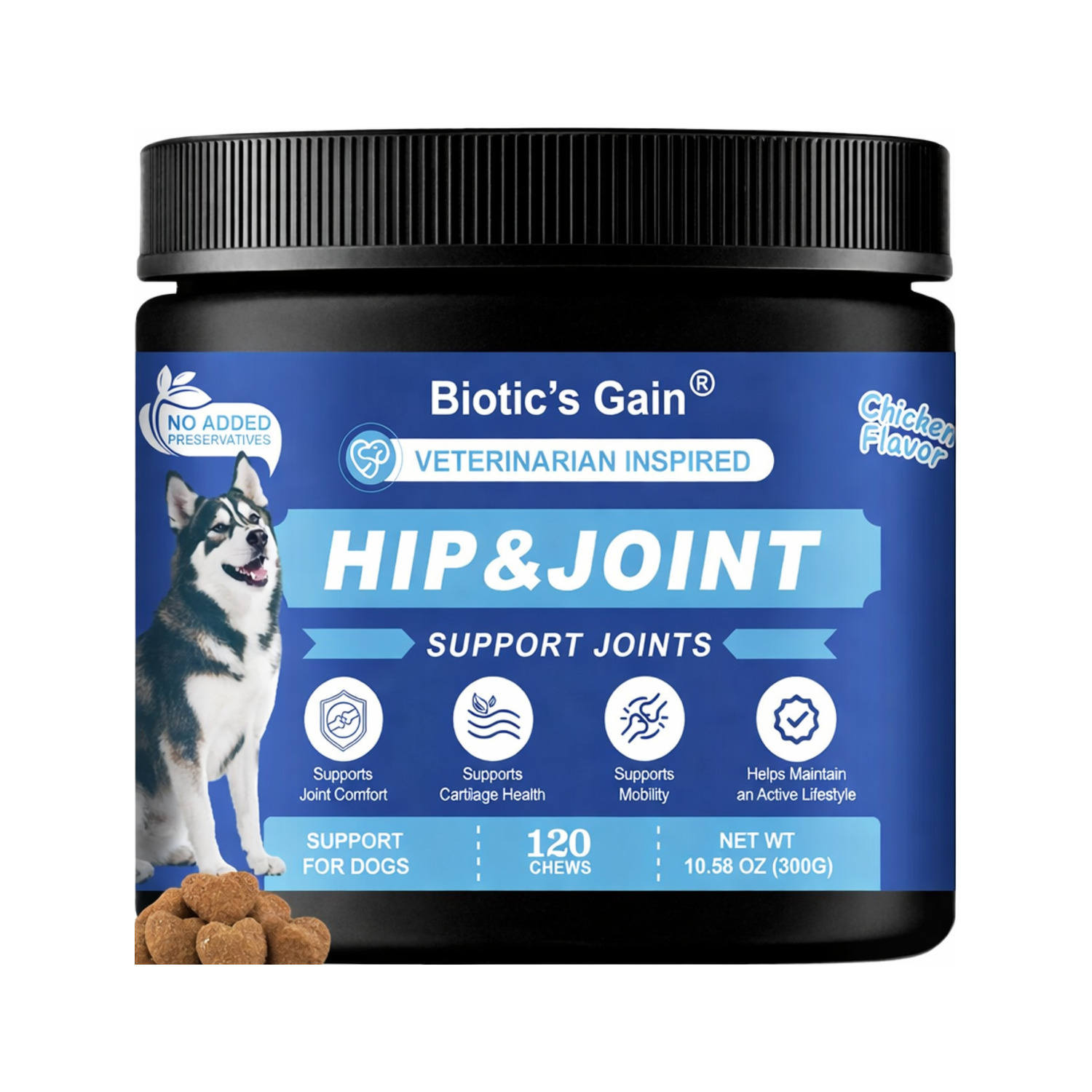
Biotic’s Gain Joint Supplements for Dogs with Glucosamine are soft chews, a complementary feed fed alongside a complete, balanced diet, to the guide on the pack, which is sized by the dog’s weight. Glucosamine is an amino sugar found naturally in cartilage. That is a description of the product, nothing more.
It is worth being plain about what cannot be said. Neither glucosamine nor chondroitin has any authorised claim in Great Britain, and phrases such as “helps maintain joint health” or “keeps joints supple and flexible” sit on the rejected list, so we do not use them. A complementary feed cannot claim to treat, prevent or cure anything. What governs how comfortably a dog moves is their weight, their fitness, the surfaces they work on and how sensibly activity is built up — and if something seems wrong with how your dog is moving, that is a vet question. What is actually in a dog joint supplement and the stiff joints guide go through the ingredients without the marketing.
When to speak to your vet
Before changing a dog’s exercise substantially, and certainly before anything strenuous, it is worth a word with your vet — particularly for a puppy, an older dog, an overweight dog or any dog with a known problem. Book an appointment if your dog:
- limps, or is stiff after exercise, even if it wears off within an hour
- is suddenly reluctant to walk, jump into the car or climb stairs
- coughs or struggles to settle their breathing after moderate activity
- cannot cope with heat, or has collapsed or wobbled on a walk at any point
- has gained or lost noticeable weight without a change in food
Your vet can also say what is reasonable for your dog’s age, breed and shape, which beats any figure in an article.
Related reading
Biotic’s Gain chews are a complementary feed for dogs, fed alongside a complete, balanced diet. A complementary feed cannot treat, prevent or cure any condition. If you have any concern about your dog’s health, movement or behaviour, speak to your vet.


Leave a Reply